Genus Calochroa Hope, 1838
(Cicindelidae)
A Review of a Colorful Asian Tiger Beetle Genus
The Ultimate Visual Guide to Tiger Beetles
Systematics
Taxonomic Position
The genus Calochroa Hope, 1838 is a member of the family Cicindelidae, the tiger beetles, representing one of the most conspicuous and colorful genera within the Asian tiger beetle fauna. Within the systematic hierarchy, this genus is classified as follows:
- Order: Coleoptera
- Suborder: Adephaga
- Family: Cicindelidae
- Tribe: Cicindelini
- Genus: Calochroa Hope, 1838


Etymology and Original Description
The generic name Calochroa was established by Frederick William Hope in 1838 in his work “The Coleopterist’s Manual, Part the Second, Containing the Predaceous Land and Water Beetles of Linnaeus and Fabricius,” published in London. Hope, a distinguished British entomologist and founder of the Hope Department of Entomology at Oxford University, made enormous contributions to insect systematics in the nineteenth century.
The name Calochroa derives from the combination of two Greek words: καλὸς (kalos) meaning “beautiful” and χρόα (chrooa) meaning “color” or “skin.” This etymology reflects Hope’s observation that most species in this genus possess rich, vibrant metallic coloration, making them among the most visually striking tiger beetles. The name thus translates approximately as “beautiful color,” an apt description for these iridescent beetles.
Taxonomic Status and Relationships
The taxonomic treatment of Calochroa has been subject to varying interpretations among specialists. Some authorities treat Calochroa as a distinct genus, while others have considered it within the broader context of the genus Cicindela Linnaeus, 1758, sometimes as a subgenus. Recent molecular phylogenetic studies have revealed that the genus as traditionally circumscribed is polyphyletic, with Calochroa species forming two distinct clades. One clade shows sister relationships to the genus Lophyra, while another clade is sister to the genus Hipparidium.
Morphological studies examining the structure of the everted internal sac of male genitalia have provided additional insights into relationships within Calochroa and with related genera including Cosmodela Rivalier, 1961. These reproductive structures have proven valuable as taxonomic characters for grouping genera and subgenera within Cicindelidae.
Species Diversity
The genus Calochroa comprises approximately 33 currently recognized species, with new species continuing to be described. Recent additions include:
- Calochroa horii Wiesner & Phyu, 2019 (from Myanmar)
- Calochroa fumikoae Wiesner & Phyu, 2019 (from Myanmar)
- Calochroa miroklichai Moravec, Dheurle & Wiesner, 2023 (from Thailand)
Some of the more widespread and well-known species include:
- Calochroa flavomaculata (Hope, 1831)
- Calochroa sexpunctata (Fabricius, 1775)
- Calochroa bicolor bicolor Fabricius, 1781
- Calochroa assamensis (Parry, 1844)
- Calochroa octonotata
- Calochroa hamiltoniana (J. Thomson, 1857)
- Calochroa tritoma (Schmidt-Goebel, 1846)
- Calochroa corbetti (W. Horn, 1899)
- Calochroa carissima Fleutiaux, 1919
- Calochroa bramani Dokhtouroff, 1882
- Calochroa anometallescens W.Horn, 1893
Recent taxonomic work has clarified long-standing identification issues within the genus. For example, Calochroa goebeli (W. Horn, 1895), previously treated either as a variety or junior synonym of C. anometallescens or confused with C. tritoma, has been demonstrated to represent a separate, valid species.
Diagnostic Characteristics
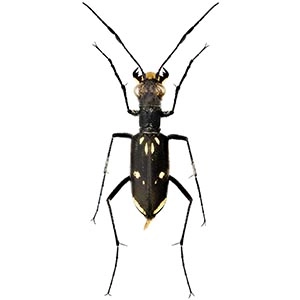
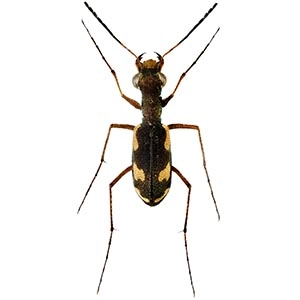
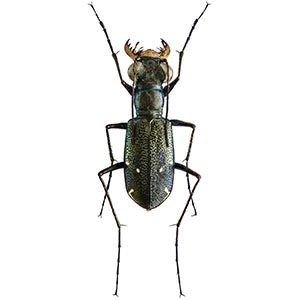
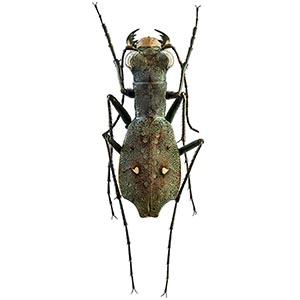
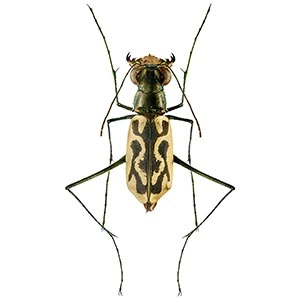
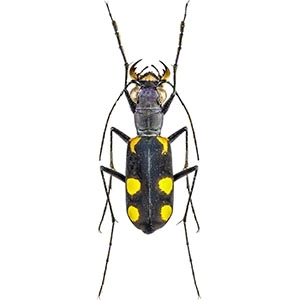
As members of the Cicindelidae, Calochroa species exhibit the characteristic features of the family: large prominent compound eyes providing excellent vision, elongate body form, long legs adapted for cursorial hunting, powerful sickle-shaped mandibles for capturing prey, and typically brilliant metallic coloration. The genus is characterized by rich colors often including blues, greens, bronzes, and purples with distinctive elytral maculation patterns that vary among species. Many species possess conspicuous spots or bands on the elytra, as referenced in specific epithets such as sexpunctata (six-spotted) and flavomaculata (yellow-spotted).
Bionomics – Mode of Life
General Biology
Like all Cicindelidae, Calochroa species are obligate predators in both larval and adult stages, playing important roles as invertebrate predators within their ecosystems. They exhibit complete metamorphosis with distinct egg, larval (three instars), pupal, and adult life stages. While general tiger beetle biology is well understood, specific detailed life history data for many Calochroa species remain limited in the published literature.
Larval Biology
Tiger beetle larvae, including those of Calochroa, are specialized ambush predators that construct vertical burrows in suitable substrate. The larva uses its large, flattened head to block the burrow entrance while waiting for passing arthropod prey. The larval stage typically consists of three progressively larger instars. Larvae possess dorsal hooks on the fifth abdominal segment that anchor them within the burrow, preventing prey from pulling them out during capture struggles. The burrow serves both as a hunting platform and a refuge from predators and adverse environmental conditions.
Adult Behavior and Ecology
Adult Calochroa are characteristically diurnal, visually-oriented hunters that actively pursue prey across terrestrial substrates. They are among the fastest-running insects, capable of remarkable bursts of speed when chasing prey or evading threats. The large compound eyes provide exceptional visual acuity essential for detecting movement and locating both prey and potential mates.
Several Calochroa species have been observed to be attracted to artificial lights at night, indicating at least some crepuscular or nocturnal activity. In surveys in northeastern India, Calochroa flavomaculata and other species have been collected using night light traps, suggesting flexibility in activity patterns or possibly representing dispersal behavior.
Some species show interesting behavioral traits related to their habitats. For example, Calochroa octonotata, noted as one of the largest tiger beetles in terms of body size, is a powerful flyer that typically occurs individually along water margins. When disturbed, it flies long distances before perching in areas of sparse vegetation, representing a flight-oriented escape strategy.
Habitat Specificity
Different Calochroa species exhibit varying degrees of habitat specificity. Field studies in India have documented distinct habitat preferences among sympatric species. Some species, such as Calochroa assamensis and Cylindera spinolae, are strictly restricted to forest habitats and have been observed perching on leaf surfaces. Others, including Calochroa flavomaculata, occur in multiple habitat types including forests and moist sandy areas, demonstrating ecological flexibility.
Ecological Role
As predators at multiple life stages, Calochroa species contribute to the regulation of smaller arthropod populations within their ecosystems. Tiger beetles are frequently considered indicator species for habitat quality and environmental health, as many species show specific habitat requirements and sensitivity to disturbance. The presence and diversity of tiger beetle assemblages, including Calochroa species, can provide insights into ecosystem integrity and conservation status.
Distribution
Geographic Range
The genus Calochroa exhibits a primarily Asian distribution spanning from Africa (possibly representing range periphery) through the Indian subcontinent to Southeast Asia. The genus reaches its greatest diversity in South and Southeast Asia, representing one of the characteristic elements of the tropical Asian tiger beetle fauna.
Regional Distribution
Indian Subcontinent: Calochroa is well represented throughout India, Pakistan, Nepal, Sri Lanka, and Bangladesh. Multiple species occur across various ecological zones from the Himalayan foothills to southern coastal regions. India alone hosts numerous Calochroa species, with documented occurrences from diverse regions including:
- Northeastern states (Assam, Meghalaya, Mizoram, Manipur)
- Northern regions (Uttar Pradesh, Himachal Pradesh, Punjab)
- Central India (Madhya Pradesh, Orissa, Bihar, Rajasthan)
- Southern India (Andhra Pradesh, Karnataka, Tamil Nadu, Kerala)
- Andaman and Nicobar Archipelagoes
Southeast Asia: The genus shows strong representation in mainland Southeast Asia, with species documented from:
- Myanmar (Burma) – Recent surveys have documented multiple species including several newly described taxa
- Thailand – Recent taxonomic work has clarified species concepts and described new species
- Laos – Comprehensive faunistic surveys have documented Calochroa diversity
- Cambodia – Species recorded from various localities
- Vietnam – Multiple species documented
- Malaysia – Peninsular Malaysia and possibly Borneo
Insular Southeast Asia: The genus extends to various islands including:
- Philippines (multiple species documented from various islands including Luzon)
- Indonesia (Sumatra, Java, possibly other islands)
East Asia: Some Calochroa species extend into:
- Southern China (multiple provinces documented)
- Hong Kong
- Taiwan
Species-Specific Distributions
Individual species show varying distribution patterns. Widespread species such as Calochroa flavomaculata and C. sexpunctata occur across much of the genus’s range, from the Indian subcontinent through Southeast Asia. Other species show more restricted distributions, being endemic to particular regions or countries. For example, recently described species are known only from specific localities in Myanmar or Thailand.
Biogeographic Patterns
The distribution of Calochroa reflects broader biogeographic patterns in Asian tiger beetle diversity. The Indian subcontinent and Southeast Asian regions represent global centers of tiger beetle diversity, with complex historical factors including tectonic movements, climatic changes, and habitat heterogeneity contributing to speciation and diversification. The genus Calochroa represents one important component of this rich fauna.
Preferred Habitats
General Habitat Associations
Species of Calochroa occupy diverse terrestrial habitats across their geographic range. As visual hunters, tiger beetles typically favor habitats providing suitable conditions for both hunting and larval development, including adequate prey availability, appropriate substrate for burrow construction, and suitable microclimatic conditions.
Riverine and Aquatic Margins
Many Calochroa species show strong associations with riverine habitats and aquatic margins. Field studies in India have documented multiple Calochroa species occurring along moist riverine sandy soils. The sandy banks formed along water margins attract numerous invertebrates due to accumulated organic matter and high food supply, providing excellent hunting grounds for adult tiger beetles. These riparian habitats offer not only abundant prey but also relative safety from certain predators and, in some cases, reduced human disturbance.
Specific observations include Calochroa octonotata occurring individually along margins of water bodies, and C. flavomaculata being documented from various aquatic-associated habitats. However, different species within the genus show varying preferences, with some occupying dry sandy areas and others favoring moist substrates.
Forest Habitats
Several Calochroa species are forest-dwelling, occurring in wooded habitats rather than open sandy areas. In northeastern India, Calochroa assamensis has been documented as strictly restricted to forest areas, where individuals perch on leaf surfaces. The presence of tiger beetles in forests and thick undergrowth vegetation, including Calochroa species, represents an important component of forest invertebrate predator assemblages.
Coastal and Sandy Habitats
Some species occupy coastal habitats and sandy areas. Documentation from India’s coastal regions, including mangroves, sandy beaches, sand dunes, and estuarine areas, includes Calochroa species among the tiger beetle assemblages. The variety of coastal habitats provides diverse ecological niches supporting different tiger beetle species with varying substrate and moisture requirements.
Substrate Requirements
Substrate characteristics are critical for tiger beetle larvae, which require suitable soil conditions for burrow construction. Substrate texture, compaction, moisture content, and stability all influence larval habitat suitability. Different Calochroa species appear to prefer different substrate types, from loose sandy soils to firmer substrates. Adults are often found where at least some exposed ground occurs, facilitating their running and hunting behavior.
Altitudinal Range
While many Calochroa species occupy lowland habitats, the genus extends across various elevational zones. Species have been documented from coastal lowlands to foothill regions and, in some cases, montane areas, reflecting the diverse topography across the genus’s Asian distribution.
Habitat Degradation and Conservation
Habitat degradation due to human activities represents a significant threat to tiger beetle populations, including Calochroa species. Riverine ecosystems face pressures from development, sand mining, pollution, and altered hydrology. Forest habitats experience deforestation, degradation, and fragmentation. Coastal areas undergo development and modification. The specific conservation status of most Calochroa species has not been formally assessed, but habitat loss likely affects populations of specialized species, particularly those with restricted distributions.
Scientific Literature Citing the Genus
Original Description and Early Taxonomic Works
Recent Taxonomic Contributions
Regional Faunal Treatments
Ecological and Biological Studies
Phylogenetic and Systematic Studies
General Cicindelidae References
Note on Taxonomy and Future Research: The genus Calochroa represents an active area of taxonomic research, with new species continuing to be described and relationships being clarified through both morphological and molecular approaches. Recent molecular phylogenetic analyses indicating polyphyly within the genus suggest that future taxonomic revisions may be necessary to achieve a natural classification reflecting evolutionary relationships.
The continued description of new species from poorly surveyed regions, particularly in Southeast Asia, indicates that the true diversity of Calochroa remains incompletely documented. Comprehensive surveys combining morphological, molecular, and ecological approaches will be essential for fully understanding species boundaries, distributions, and conservation needs within this colorful and diverse genus.
Future research priorities include: comprehensive molecular phylogenetic analyses to resolve relationships and address polyphyly; detailed ecological studies of habitat requirements and life history for poorly known species; comprehensive surveys in understudied regions; and conservation status assessments for species with restricted distributions or specialized habitat requirements. Such research will contribute to our understanding of Asian tiger beetle diversity and support evidence-based conservation planning for these charismatic predatory insects.