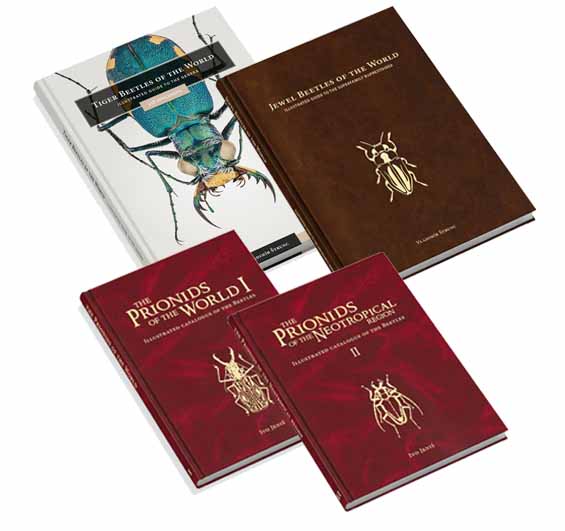
Subfamily Prioninae of the World I
An Illustrated Geographical Guide
Prioninae of the World Series – Volume I
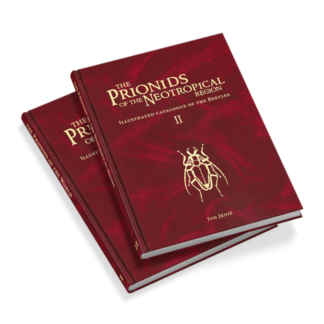
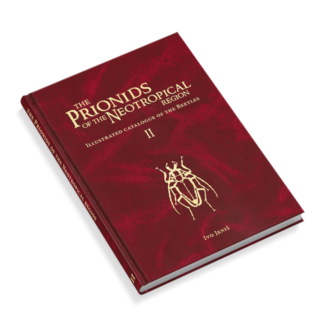
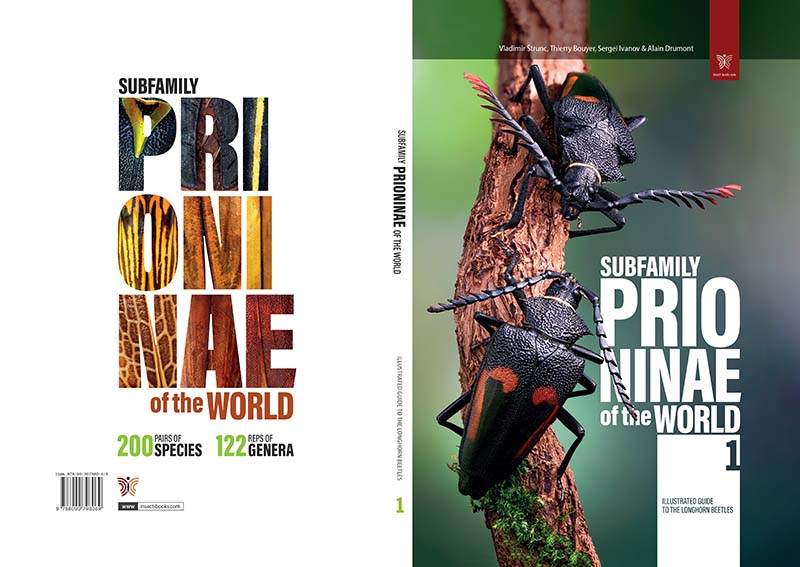
Subfamily Prioninae of the World I is the inaugural volume of the Prioninae of the World series and represents a comprehensive encyclopedic treatment of one of the most remarkable subfamilies within the longhorn beetle family Cerambycidae. Conceived as an illustrated geographical guide, this volume synthesizes global taxonomic knowledge of Prioninae and builds directly upon the earlier foundational works The Prionids of the World and The Prionids of the Neotropical Region.
The book was produced through close collaboration between internationally recognized specialists—Vladimír Štrunc, Thierry Bouyer, Sergei Ivanov, and Alain Drumont—ensuring a high level of scientific accuracy, taxonomic consistency, and global relevance.


Scientific Scope and Conceptual Framework
Prioninae comprise some of the largest and most morphologically imposing beetles known, often characterized by massive bodies, powerful mandibles, robust legs, and pronounced sexual dimorphism. They occupy a wide range of forested ecosystems worldwide and are frequently associated with old-growth habitats, where their larvae develop in large trunks and roots of woody plants.
This volume adopts a global perspective, treating Prioninae as a coherent evolutionary and biogeographical unit while recognizing the substantial regional diversification that characterizes the subfamily. The work functions both as a taxonomic reference and as a visual synthesis of worldwide prionine diversity.
Illustrated Atlas and Identification Value
At the core of the book is an extensive illustrated section comprising approximately 400 high-quality images representing 200 species across 122 genera. Each species is documented through carefully selected photographic views designed to support accurate identification and comparative morphology.
Unlike earlier regional volumes, this guide systematically presents both male and female specimens wherever possible, allowing readers to assess sexual dimorphism—a critical feature in many prionine taxa.
Each illustrated specimen is accompanied by:
-
bionomic and ecological notes,
-
precise collection locality,
-
a distribution map indicating both known range and capture site,
-
information on actual body size and sex.
Several of the illustrated species are published here for the first time, making this volume a significant contribution to the visual documentation of Prioninae worldwide.
Taxonomic Coverage and Genera Diversity
The book offers exceptionally broad generic coverage, including an extensive array of Prioninae genera from all major zoogeographical regions. The represented genera span classic, well-known lineages (Prionus, Titanus, Callipogon, Macrodontia, Mallodon, Orthomegas, Psalidognathus) as well as numerous specialized, rare, and recently revised taxa.
The inclusion of newly described or recently redefined genera (e.g. Basorus, Cnemoplitodes, Drumontia) reflects the current state of Prioninae systematics, incorporating recent taxonomic advances and nomenclatural updates.
This breadth makes the volume an unparalleled reference for understanding generic diversity, morphological disparity, and evolutionary relationships within Prioninae.
Subfamily Prioninae of the World I.
The Prionids of the World
The Prionids of the Neotropical Region
The Prionids Collection Bundle
Complete Species List and Reference Function
In addition to the illustrated material, the book includes a complete checklist of all currently known Prioninae species, providing a crucial taxonomic baseline for researchers, curators, and collectors. This checklist consolidates scattered literature and aligns species concepts within a unified systematic framework.
As such, the volume serves not only as an identification guide but also as a long-term reference tool for:
-
taxonomic revision,
-
biodiversity inventories,
-
museum collection management,
-
biogeographical and evolutionary studies.
Methodological and Educational Significance
The introductory chapters contextualize Prioninae within Cerambycidae, clarifying:
-
defining morphological characters of the subfamily,
-
historical changes in taxonomic boundaries,
-
distinctions between Prioninae sensu stricto and formerly associated groups.
The authors also introduce readers to modern classification approaches, including molecular and DNA-based methods, highlighting how contemporary phylogenetic research is reshaping our understanding of prionine relationships while complementing traditional morphology-based taxonomy.
Types Subfamily Prioninae
Production Quality and Physical Format
The book is produced as a large-format A4 hardcover volume, designed to accommodate detailed imagery and maps. Key production features include:
-
heavyweight paper (170 g/m²) optimized for photographic reproduction,
-
excellent image resolution suitable for fine morphological study,
-
durable binding for long-term use in libraries and collections.
ISBN: 978-80-907980-6-9
Extent: 148 pages
Audience and Scholarly Value
Subfamily Prioninae of the World I is intended for:
-
professional entomologists and coleopterists,
-
taxonomists and systematists,
-
museum curators and collection managers,
-
biodiversity researchers and conservation specialists,
-
advanced amateur beetle specialists.
By combining global taxonomic synthesis, rigorous documentation, and outstanding visual material, this volume represents a cornerstone reference for the study of Prioninae and establishes a solid foundation for subsequent volumes in the Prioninae of the World series.