Titanus giganteus (Linnaeus, 1771)
Taxonomic Classification
Kingdom: Animalia
Phylum: Arthropoda
Class: Insecta
Order: Coleoptera
Family: Cerambycidae
Subfamily: Prioninae
Tribe: Prionini
Genus: Titanus
Species: T. giganteus
Common Names: Titan beetle, Giant long-horned beetle
Morphological Description
General Characteristics
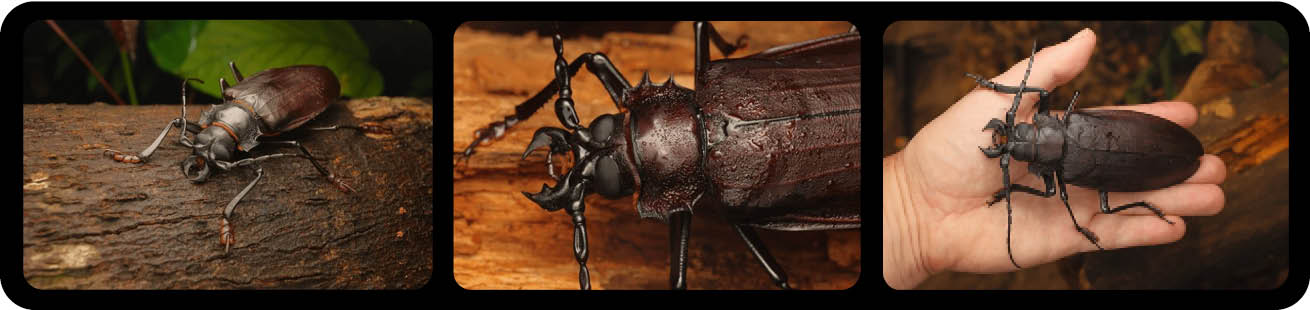
Titanus giganteus represents one of the largest beetle species in the world, with specimens reaching exceptional dimensions. This species exhibits the characteristic elongated body plan typical of cerambycid beetles, combined with robust morphological features adapted to its ecology. Wikipedia
Distribution an


Size and Dimensions
Adult specimens demonstrate considerable size variation:
- Body length: 120-167 mm (typically 140-160 mm)
- Maximum recorded length: 167 mm (excluding antennae)
- Body width: 40-60 mm at the widest point (elytra)
- Antennal length: Approximately 50-70% of body length in males
Head and Mouthparts
The head is prognathous and moderately deflexed, with well-developed mandibles characteristic of the Prioninae. The mandibles are powerful, curved, and capable of generating significant bite force. In males, mandibles are more robust and elongated compared to females. The compound eyes are reniform (kidney-shaped) and moderately emarginate. Antennae are eleven-segmented, serrate, and inserted at the anterior margin of the eyes.
Subfamily Prioninae of the World I.
The Prionids of the World
The Prionids of the Neotropical Region
The Prionids Collection Bundle
Thorax
The pronotum is transverse, broader than long, with three distinct lateral spines on each side. The surface is coarsely punctate with a median longitudinal impression. The scutellum is triangular and slightly pubescent. The prosternum exhibits a broad intercoxal process. The mesosternum and metasternum are densely punctate.
Elytra
The elytra are elongate, parallel-sided, and cover the entire abdomen. Coloration ranges from dark reddish-brown to nearly black, with a subtle lustrous sheen. The elytral surface is coarsely and irregularly punctate, with each elytron possessing three weak costae (longitudinal ridges). The apex of each elytron is individually rounded or slightly truncate, occasionally with a small sutural spine.
Legs
All legs are robust and well-developed. Tarsal formula is 5-5-5, with the fourth tarsomere bilobed. Tibiae possess apical spurs. Claws are simple, without teeth. The femora are moderately clavate (club-shaped), with the metafemora being the most robust.
Sexual Dimorphism
Sexual dimorphism is moderate but observable:
- Males: Slightly smaller on average, more elongate antennae, more developed mandibles, narrower abdomen
- Females: Larger and more robust body, shorter and thicker antennae, broader abdomen for egg production
Geographic Distribution
Titanus giganteus is endemic to the northern regions of South America, with confirmed distribution in the following areas:
- Venezuela: Northern states, particularly in humid forest regions
- Colombia: Eastern lowlands and Amazonian regions
- Ecuador: Eastern Amazonian provinces
- Peru: Loreto, Ucayali, and Madre de Dios departments
- Brazil: Amazonas, Pará, and Acre states (most common)
- French Guiana: Interior tropical forests
- Guyana and Suriname: Sporadic records
The species appears to be most abundant in the Brazilian Amazon basin, particularly in primary rainforest habitats.
Habitat and Ecology
Habitat Preferences
Titanus giganteus inhabits lowland tropical rainforests, typically below 1,000 meters elevation. The species shows preference for:
- Primary humid tropical forest
- Areas with high canopy cover and dense vegetation
- Regions with abundant decaying hardwood trees
- Temperature ranges of 24-28°C with high humidity (>80%)
Life Cycle and Development
The complete life cycle of Titanus giganteus remains partially understood due to the cryptic nature of immature stages.
Larval Stage
Larvae are presumed to develop in decaying wood of large tropical hardwood trees, based on morphological characteristics and related species biology. The larval stage is believed to last 3-5 years, though this has not been definitively confirmed through field observation. Larvae likely bore through heartwood, creating extensive galleries as they feed. No larva has been definitively identified and described in scientific literature, making this one of the most significant gaps in our knowledge of the species.
Pupal Stage
The pupal stage is similarly undescribed but is presumed to occur within the larval gallery in the wood substrate. Duration is estimated at several weeks to months.
Adult Stage
Adults emerge during the wet season (typically November to February in most of their range). Adult beetles are attracted to light sources and are most active during warm, humid nights. Unlike many cerambycids, adults appear to be non-feeding or feed minimally, relying on energy reserves accumulated during larval development. Adult lifespan is relatively short, estimated at 3-5 weeks, during which reproduction is the primary activity.
Behavior
Adult Titanus giganteus exhibits several characteristic behaviors:
Activity Patterns: Primarily nocturnal, with peak activity occurring in the first few hours after sunset. During daylight hours, individuals remain concealed in tree bark crevices or ground debris.
Flight Capability: Despite their large size and weight (adults can exceed 50 grams), T. giganteus are capable fliers. Flight is typically brief and appears to be primarily dispersal-oriented rather than foraging-related.
Defensive Behavior: When threatened, adults produce audible hissing sounds (stridulation) by rubbing body parts together. They can also deliver powerful bites with their mandibles, capable of breaking pencils or drawing blood from handlers.
Reproductive Behavior: Specific mating behaviors remain poorly documented in natural settings. Pheromone communication is presumed based on patterns observed in related prionine species.
Conservation Status
Current Status
Titanus giganteus is not currently listed by the IUCN Red List, representing a significant gap in conservation assessment. However, several factors warrant concern:
Threats
- Habitat Loss: Deforestation in the Amazon basin represents the primary threat, with ongoing conversion of primary forest to agriculture and development
- Climate Change: Alterations to temperature and precipitation patterns may affect suitable habitat
- Collection Pressure: High commercial value in the insect trade creates incentive for collection
- Limited Data: Lack of population data prevents accurate assessment of conservation needs
Conservation Considerations
The species would benefit from:
- Systematic population surveys across its range
- Protection of primary rainforest habitats
- Regulation of commercial collection
- Further research into life history and ecology
Research History and Significance
Discovery and Description
Titanus giganteus was first described by Carl Linnaeus in 1771 based on specimens from South America. The species has fascinated entomologists and naturalists since its discovery due to its exceptional size.
Scientific Importance
The species holds significance for several areas of research:
Biomechanics: The ability of such large beetles to achieve powered flight presents interesting questions about insect flight mechanics and scaling relationships.
Evolutionary Biology: As one of the largest beetles, Titanus giganteus represents an extreme in insect body size evolution, offering insights into size limitations and advantages.
Ecology: Understanding the ecological role of such large wood-boring beetles in tropical forest ecosystems contributes to our knowledge of nutrient cycling and forest dynamics.
Research Gaps
Critical gaps in our knowledge include:
- Complete life cycle description, particularly larval stages
- Host plant preferences and specificity
- Population dynamics and density estimates
- Detailed reproductive biology
- Genetic diversity and population structure
Collecting and Curation
Collection Methods
Specimens are typically obtained through:
- Light trapping: Mercury vapor or UV lights during wet season nights
- Incidental encounters: Discovery during forest surveys
- Indigenous knowledge: Local communities sometimes encounter adults or are aware of emergence patterns
Preparation
Proper curation of specimens requires:
- Pinning through the right elytron
- Relaxing specimens if dried
- Spreading legs and antennae in standard position
- Detailed locality data labels
- Storage in pest-free conditions with appropriate humidity control
Commercial Trade
Titanus giganteus specimens command high prices in the insect trade, with pristine specimens selling for several hundred dollars. This creates both conservation concerns and economic opportunities for local communities. Sustainable collection practices and regulation are essential topics for consideration.
Related Species
Genus Titanus
The genus Titanus contains only one valid species, Titanus giganteus, making it monotypic. Historical records of other species have been synonymized or reclassified.
Similar Large Cerambycids
Other notably large longhorn beetles include:
- Xixuthrus heros (Fiji) – 120-150 mm
- Macrodontia cervicornis (South America) – 130-170 mm including mandibles
- Callipogon relictus (Eastern Asia) – up to 110 mm
While Macrodontia cervicornis may occasionally exceed Titanus giganteus in total length when extremely long mandibles are included, T. giganteus is generally considered to have the greatest body mass and volume.
Cultural and Economic Aspects
Indigenous Perspectives
Indigenous peoples throughout the Amazon have traditional knowledge of Titanus giganteus. In some cultures, the beetles are incorporated into folklore or traditional practices. The spectacular size and strength of the beetles have made them subjects of stories and traditional observations about forest health and seasonal changes.
Economic Considerations
The species generates economic activity through:
- Scientific specimen sales
- Educational displays and exhibitions
- Ecotourism opportunities
- Photographic subjects
Conclusion
Titanus giganteus represents one of the most spectacular insects on Earth and an important component of Neotropical forest biodiversity. Despite over two centuries of scientific awareness, significant aspects of its biology remain mysterious, particularly the larval stages and detailed ecology. Continued research combined with habitat conservation will be essential to ensure this magnificent species persists for future generations to study and appreciate. The beetle serves as an important flagship species for Amazon conservation and reminds us how much remains to be discovered about even the largest and most conspicuous organisms in tropical ecosystems.