Prionus coriarius (Linnaeus, 1758)
Classification
The taxonomic classification of Prionus coriarius is as follows:
Kingdom: Animalia
Phylum: Arthropoda
Class: Insecta
Order: Coleoptera
Suborder: Polyphaga
Infraorder: Cucujiformia
Superfamily: Chrysomeloidea
Family: Cerambycidae
Subfamily: Prioninae
Tribe: Prionini
Genus: Prionus Geoffroy, 1762
Species: Prionus coriarius (Linnaeus, 1758)
Synonymy
Cerambyx coriarius Linnaeus, 1758 (original combination)
Prionus coriarius coriarius (Linnaeus, 1758) (nominal subspecies)
The genus Prionus is one of the most species-rich genera within Prioninae, with over 200 described species distributed primarily in the Holarctic region. Prionus coriarius is the type species and serves as the taxonomic reference for the genus. The specific epithet “coriarius” derives from Latin, meaning “leather-like,” referring to the texture of the elytra. Wikipedia
Distribution an


Common Names
Prionus coriarius is commonly known as the “Tanner beetle” or “Leather beetle” in English, “Sägebock” or “Gerber” in German, “prione tanneur” in French, and “tesařík koželužský” in Czech. These vernacular names reflect the leathery appearance of the elytra and historical associations with tanneries where the species was occasionally encountered.
Subfamily Prioninae of the World I.
The Prionids of the World
The Prionids of the Neotropical Region
The Prionids Collection Bundle
Morphology
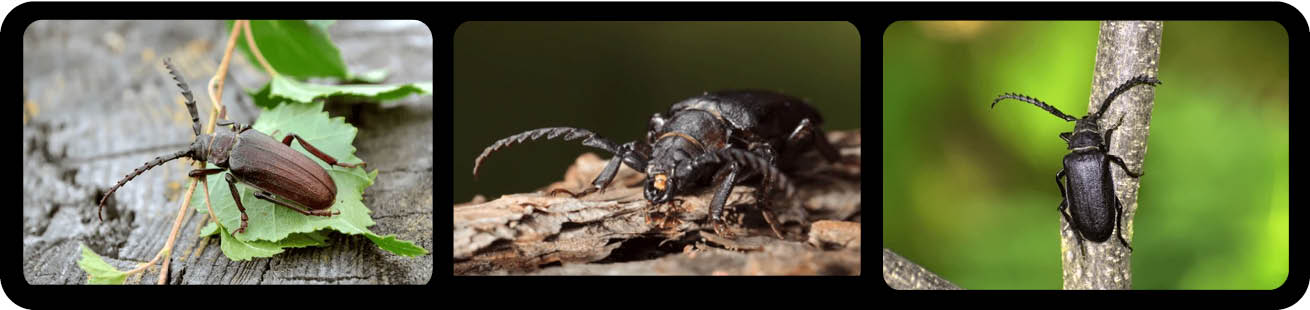
Prionus coriarius is among the largest longhorn beetles in Europe, exhibiting considerable size variation and sexual dimorphism.
Adult Morphology
Adults measure 18-50 mm in body length, with females typically larger than males. The body is robust, elongate-ovate, and strongly built with a characteristic prionine appearance. Coloration is uniformly dark brown to black with a slightly reddish or pitch-black hue. The integument has a leathery texture with fine, dense punctation.
The head is relatively small compared to the pronotum, deeply inserted into the prothorax. Compound eyes are reniform (kidney-shaped) and moderately emarginate. The clypeus is well-defined, and the labrum is distinct. Mandibles are robust, curved, and well-developed in both sexes, though more pronounced in males.
Antennae are strongly serrate, particularly in males, and consist of 12 segments—a diagnostic feature distinguishing Prionus from many other prionine genera that typically possess 11 antennal segments. In males, antennae extend to approximately two-thirds of body length with segments 3-11 produced into pronounced triangular projections. Female antennae are shorter, reaching about half the body length, with less prominent serrations.
The pronotum is transverse (broader than long), strongly convex, with three sharp lateral teeth on each side. The surface is coarsely and irregularly punctate with a median longitudinal impression. The scutellum is relatively small and triangular.
Elytra are elongate, parallel-sided, covering the entire abdomen, and possess three distinct longitudinal costae (ridges) on each elytron. The elytral surface is coarsely rugose-punctate with a characteristic leathery appearance. The elytra taper slightly toward the apex, which is individually rounded or subtruncate.
Legs are robust and adapted for walking and digging. Femora are clavate (club-shaped), particularly the hind femora. Tibiae possess two apical spurs. The tarsal formula is 5-5-5, with the fourth tarsomere distinctly bilobed. Tarsal claws are simple, without teeth.
Larval Morphology
Larvae are typical prionine grubs, reaching 60-80 mm in length when fully developed. The body is elongate, cylindrical, fleshy, and creamy-white to pale yellowish in color. The head capsule is heavily sclerotized, broad, and dark reddish-brown to black.
The thoracic segments are swollen, particularly the prothorax, while abdominal segments are relatively uniform in diameter. Thoracic legs are present but reduced, consisting of three segments with small claws. The body surface bears numerous setae and dorsal ampullae (tubercles) that aid in locomotion within substrate.
The larval head possesses powerful mandibles adapted for chewing through roots and wood. Stemmata (simple eyes) are absent or vestigial, consistent with the subterranean lifestyle.
Biology and Life Cycle
Prionus coriarius exhibits one of the most distinctive life cycles among European Cerambycidae, being primarily a root-feeding species rather than a wood-borer during the larval stage.
Developmental Period
The complete life cycle is prolonged, typically requiring 3-5 years from egg to adult, though this can extend to 6-7 years under suboptimal conditions. Development time is influenced by temperature, soil conditions, host plant quality, and nutritional availability.
Adult Biology
Adults are crepuscular and nocturnal, with peak activity occurring during warm summer evenings. The flight period extends from June through September in most of Europe, with maximum emergence typically in July and August. Males emerge slightly earlier than females and are more frequently encountered at artificial lights.
Flight capability varies between sexes. Males are capable fliers and actively seek females, often covering considerable distances. Females, being larger and heavier-bodied, are less active fliers and may remain in or near their emergence sites.
Adults are attracted to artificial light sources, particularly mercury vapor and UV lights, which facilitates their observation and collection. Pheromone communication plays a crucial role in mate location, with females producing volatile compounds that attract males from distances potentially exceeding 100 meters.
Adult feeding is minimal or absent. Some individuals may consume plant sap, honeydew, or moisture, but adults do not require substantial nutrition and rely primarily on larval-accumulated reserves. Adult longevity ranges from 2-6 weeks.
Mating and Oviposition
Mating typically occurs on or near the ground, on tree trunks, or on vegetation. Males locate females through pheromone detection and may compete for mating opportunities. Courtship is relatively brief, with mating lasting several hours.
Females possess a robust, extensible ovipositor capable of penetrating soil to deposit eggs near roots or in organic-rich substrate. Oviposition sites are carefully selected based on soil moisture, organic content, and proximity to suitable host plant roots. Eggs are laid individually or in small clusters at depths of 5-20 cm below the surface.
A single female may produce 200-400 eggs during her lifetime, though fecundity varies with female size and condition. Eggs are oval, white to cream-colored, and measure approximately 3-4 mm in length. Incubation lasts 2-4 weeks depending on soil temperature.
Larval Development and Feeding
Newly hatched larvae immediately begin feeding on fine rootlets and organic matter. As they develop, larvae attack progressively larger roots, including substantial woody roots of living trees. This root-feeding habit distinguishes Prionus coriarius from most other European prionines, which are primarily wood-boring species.
Larvae are subterranean throughout development, typically found at depths of 10-50 cm, occasionally deeper. They create irregular galleries and chambers within the root system and surrounding soil, packed with frass and chewed root material. Feeding is most intense during warmer months, with reduced activity or quiescence during winter.
Larval development proceeds through multiple instars, probably 8-12 stages, though precise instar numbers are difficult to determine due to the prolonged and variable development period. Growth is most rapid during the second and third years.
Pupation
When fully developed, mature larvae construct pupal chambers in soil, usually 20-40 cm deep, in proximity to roots or stumps. The chamber is oval, somewhat compacted, and may be partially lined with soil particles and frass. Chamber construction typically occurs in spring (April-May).
Pupation occurs in late spring to early summer, with the pupal stage lasting 3-5 weeks. Pupae are exarate (free-limbed), pale yellowish initially, darkening as metamorphosis progresses. Newly emerged adults may remain in the pupal chamber for several days to weeks, allowing the integument to harden and darken before excavating to the surface.
Ecology
Host Plants and Substrate Requirements
Prionus coriarius exhibits relatively broad host plant polyphagy, attacking roots of various deciduous and, less commonly, coniferous trees and shrubs. The species shows preference for trees growing in warm, well-drained soils with substantial organic content.
Primary hosts include:
- Oaks (Quercus spp.) – particularly Q. robur and Q. petraea
- Beech (Fagus sylvatica)
- Poplars (Populus spp.)
- Willows (Salix spp.)
- Birches (Betula spp.)
- Alders (Alnus spp.)
- Fruit trees – including Prunus, Malus, Pyrus
- Grapevine (Vitis vinifera)
- Conifers – occasionally Pinus and Picea spp.
Larvae attack both living and dead roots but show preference for roots of declining, stressed, or recently dead trees. The species is often associated with forest edges, clearings, orchards, vineyards, and parklands where individual trees or small groups grow in favorable soil conditions.
Habitat Requirements and Distribution Patterns
Prionus coriarius occupies diverse habitats characterized by presence of suitable host plants and appropriate soil conditions:
Habitat types:
- Mixed deciduous and coniferous forests, particularly edge zones
- Open woodlands and wood-pastures
- Orchards and fruit plantations
- Vineyards
- Parks, gardens, and urban green spaces
- Riparian zones and floodplain forests
- Old hedgerows with mature trees
- Forest clearings and recently harvested areas
Critical habitat features:
- Well-drained, sandy to loamy soils
- Warm microclimates (south-facing slopes, forest edges)
- Adequate soil organic content
- Presence of veteran or declining trees
- Tree stumps and root systems remaining after felling
The species shows preference for thermophilous (warm-loving) habitats and is generally more abundant in lowland and colline zones, though it can occur up to approximately 1500 m elevation in mountainous regions.
Soil and Microhabitat Preferences
Soil characteristics significantly influence Prionus coriarius distribution and abundance. The species preferentially colonizes:
- Light, sandy, or sandy-loam soils that facilitate larval movement and female oviposition
- Well-drained soils avoiding waterlogged conditions
- Soils with pH 5.5-7.5 (slightly acidic to neutral)
- Warm soils with good sun exposure
- Soils rich in organic matter supporting root growth and decomposition
Microhabitat selection by ovipositing females appears influenced by soil temperature, moisture content, and presence of root volatiles. Larvae are typically more abundant near tree stumps, around bases of declining trees, and in areas where root mortality has occurred.
Associated Organisms and Ecological Interactions
Prionus coriarius participates in complex ecological networks within its habitats:
Fungal Associations:
Larval galleries in roots are frequently colonized by wood-decay fungi, particularly white-rot species such as Armillaria spp., Heterobasidion spp., and Ganoderma spp. These fungi may facilitate larval nutrition by pre-digesting woody tissue and providing nitrogen-rich mycelium. The relationship may be facultatively mutualistic, with fungi benefiting from larval dispersal and increased substrate accessibility.
Predators and Parasitoids:
Larvae are attacked by various natural enemies including:
- Parasitoid wasps (Ichneumonidae, Braconidae)
- Parasitic flies (Tachinidae)
- Predatory beetles (Carabidae, Staphylinidae)
- Insectivorous mammals (shrews, moles, wild boar)
- Birds, particularly woodpeckers that excavate roots
Adults are preyed upon by bats, nocturnal birds, and various predatory arthropods.
Commensal and Secondary Colonizers:
Root galleries and pupal chambers created by Prionus coriarius provide microhabitats for numerous other organisms including mites, springtails, nematodes, and other soil invertebrates.
Ecological Role and Ecosystem Functions
Prionus coriarius performs several important ecological functions:
Nutrient Cycling:
Larval feeding on roots accelerates decomposition of underground woody biomass, releasing nutrients into soil and making them available for plant uptake and microbial processes. The species contributes significantly to carbon and nitrogen cycling in forest ecosystems.
Soil Structure Modification:
Larval burrowing activity increases soil porosity, improves aeration, and enhances water infiltration. Gallery systems may persist for years, creating channels for root growth and soil fauna movement.
Tree Mortality and Forest Dynamics:
While Prionus coriarius preferentially attacks stressed or declining trees, heavy infestations can accelerate tree mortality, particularly in orchards and vineyards. This contributes to natural thinning processes and creation of deadwood resources in forest ecosystems.
Indicator Value:
The species serves as an indicator of habitat continuity, presence of veteran trees, and traditional land-use practices such as extensive orcharding and wood-pasture management.
Distribution
Prionus coriarius exhibits a broad Palearctic distribution, being one of the most widespread prionine species in the region.
Geographic Range:
The species occurs throughout most of Europe from the Iberian Peninsula (Spain, Portugal) and British Isles eastward through Central and Eastern Europe to the Caucasus, Turkey, and into Central Asia. The northern limit extends to southern Scandinavia (approximately 60°N), including southern Sweden and southern Finland. In the south, the species occurs throughout the Mediterranean region including North Africa (Morocco, Algeria, Tunisia).
The distribution extends eastward through Russia to Siberia, the Russian Far East, Kazakhstan, and parts of China, Korea, and Japan, though some eastern populations may represent distinct taxa requiring taxonomic revision.
Vertical Distribution:
Prionus coriarius occurs from sea level to approximately 1500-1800 m elevation in mountainous regions, with highest abundance typically in lowland and colline zones below 800 m.
Distribution Patterns:
Within its range, the species shows patchy distribution correlating with habitat suitability, particularly soil type and host plant availability. Populations may be locally abundant in optimal habitats (e.g., sandy forest edges, old orchards) while absent from intervening areas with unsuitable conditions.
Conservation Status and Threats
The conservation status of Prionus coriarius varies regionally. Overall, the species is considered widespread and locally common throughout much of its range. However, population declines have been documented in some regions.
Conservation Status
- IUCN Red List: Not evaluated globally
- European Red List: Not listed as threatened (Least Concern or Data Deficient in most assessments)
- National Red Lists: Listed as Near Threatened, Vulnerable, or of conservation concern in several Central European countries including parts of Germany, Austria, Czech Republic, and Switzerland
- Legal Protection: Protected species in some countries and regions
Threats and Declining Factors
Habitat Loss and Degradation:
- Intensive agriculture eliminating hedgerows and scattered trees
- Urbanization and infrastructure development
- Conversion of traditional orchards and wood-pastures to intensive production systems
- Removal of veteran trees and stumps from landscapes
Forest Management Practices:
- Removal of declining trees before natural mortality
- Stump extraction and root removal
- Short rotation forestry reducing tree age diversity
- Soil compaction from heavy machinery
Agricultural Intensification:
- Abandonment of traditional extensive orcharding
- Vineyard intensification and soil management
- Pesticide use in orchards and agricultural landscapes
- Deep plowing and soil disturbance
Climate and Environmental Change:
- Soil moisture regime changes affecting larval survival
- Altered phenology potentially disrupting life cycle synchronization
- Increased frequency of drought events in some regions
Conservation and Management Recommendations
Habitat Management:
- Retention of veteran and declining trees in forests and landscapes
- Leaving stumps and root systems in situ following tree felling
- Maintaining warm, open forest edges and clearings
- Conservation of traditional orchards and wood-pastures
Forestry Practices:
- Retaining individual trees beyond economic rotation age
- Creating high stumps and leaving root boles
- Avoiding soil compaction in sensitive areas
- Maintaining structural diversity in managed forests
Agricultural Landscapes:
- Supporting extensive orchard management
- Maintaining scattered trees in agricultural areas
- Reducing pesticide applications near potential habitats
- Preserving traditional land-use practices
Protected Areas:
- Including the species in habitat management plans
- Monitoring populations in key sites
- Protecting representative habitats across the distribution range
Economic Significance
Historical and Current Impact
Historically, Prionus coriarius was occasionally considered a pest in various contexts:
Forestry:
The species was implicated in damage to forest plantations, particularly in nurseries and young stands where root feeding could cause seedling mortality or growth reduction. However, economic impact in forestry has generally been minor and localized.
Fruit Production:
In orchards, particularly those with older trees or those managed extensively, Prionus coriarius infestations could weaken trees by damaging root systems. Heavily infested trees showed reduced vigor, increased susceptibility to windthrow, and occasionally died. This was primarily a concern in traditional orcharding rather than modern intensive systems.
Viticulture:
Root damage in vineyards occasionally caused concern, particularly in regions with suitable soil conditions for the species. Infested vines showed reduced productivity and longevity.
Contemporary Status:
In modern intensive agriculture and forestry, Prionus coriarius is rarely considered an economically significant pest. Rapid crop rotation, soil management practices, and overall intensification have generally reduced populations to levels where economic impact is negligible. The species is now more frequently valued for its ecological role and conservation interest than regarded as a pest.
Benefits and Ecosystem Services
From a contemporary perspective, Prionus coriarius provides valuable ecosystem services:
- Contribution to nutrient cycling and soil formation
- Support of biodiversity through habitat creation
- Indicator of sustainable land management practices
- Educational and scientific value
The species exemplifies the changing perspective on saproxylic insects from agricultural pests to valued components of biodiversity deserving conservation attention.