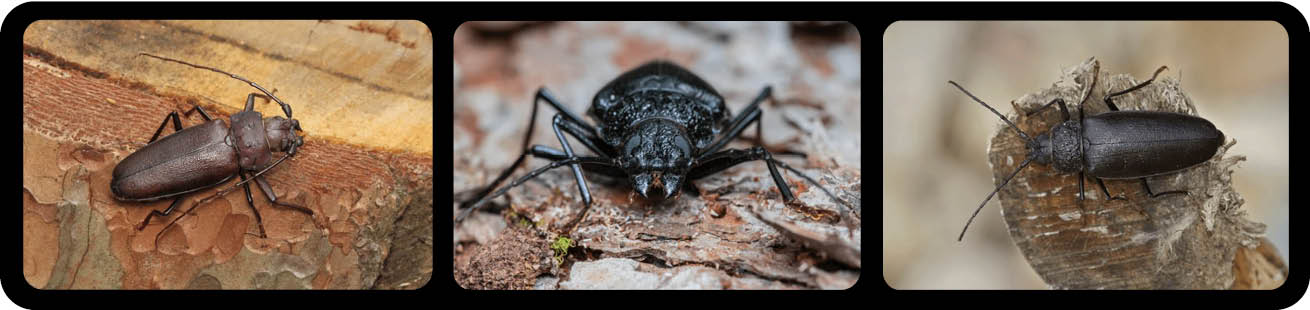
Ergates faber (Linnaeus, 1761)
Classification
The taxonomic classification of Ergates faber is as follows:
Kingdom: Animalia
Phylum: Arthropoda
Class: Insecta
Order: Coleoptera
Suborder: Polyphaga
Infraorder: Cucujiformia
Superfamily: Chrysomeloidea
Family: Cerambycidae
Subfamily: Prioninae
Tribe: Ergatini
Genus: Ergates Audinet-Serville, 1832
Species: Ergates faber (Linnaeus, 1761)
Synonymy
Cerambyx faber Linnaeus, 1761 (original combination)
Ergates faber faber (Linnaeus, 1761) (nominal subspecies)
The genus Ergates is primarily Holarctic in distribution, with E. faber being the type species. Several subspecies have been described across its range, though taxonomic revision continues regarding their validity. The tribe Ergatini contains relatively few genera but includes some of the largest prionine beetles in their respective regions. Wikipedia
Distribution an

Common Names
Ergates faber is commonly known as the “Tanner” or “Timberman beetle” in English-speaking regions, reflecting its association with wood and timber. In German-speaking areas, it is called “Mulmbock” or “Schusterbock.”
Subfamily Prioninae of the World I.
The Prionids of the World
The Prionids of the Neotropical Region
The Prionids Collection Bundle
Morphology
Ergates faber is one of the largest cerambycid beetles in Europe and North America, with adults measuring 25-60 mm in body length, occasionally reaching 65 mm. The species exhibits pronounced sexual dimorphism, with males generally larger and possessing more robust mandibles than females.
The body is elongate, parallel-sided, and dorsoventrally flattened, with coloration ranging from dark reddish-brown to nearly black. The integument has a somewhat dull, matte appearance with fine punctation. The pronotum is broader than long, with three distinct teeth on each lateral margin and a characteristic rough, granulated surface texture.
Male antennae are notably robust and extend to approximately half the body length, consisting of 11 segments that are strongly serrate. Female antennae are similar but relatively shorter and less robust. The mandibles are sexually dimorphic—males possess large, curved, heavily sclerotized mandibles that cross at the tips, while female mandibles are smaller and more symmetrical. The compound eyes are deeply emarginate (kidney-shaped), a characteristic feature of many Prioninae. The tarsal formula is 5-5-5, with the fourth tarsomere bilobed.
Larvae are typical prionine borers, reaching 60-80 mm when fully developed. They are creamy-white with a well-sclerotized, dark brown head capsule and reduced thoracic legs. The body is cylindrical, fleshy, and segmented, with dorsal ampullae (swellings) that aid movement within galleries.
Biology and Life Cycle
Ergates faber exhibits a prolonged developmental period characteristic of many prionine species. The complete life cycle typically requires 3-6 years, though development time varies considerably depending on temperature, wood quality, moisture content, and nutritional value of the substrate.
Adult Biology
Adults are crepuscular and nocturnal, emerging primarily during summer months (June-September in Europe, with peak emergence in July-August). They are strongly attracted to artificial light sources and to volatiles emitted by host trees. Adult longevity is relatively short, typically 2-4 weeks, during which time reproduction is the primary activity. Adults do not feed or feed only minimally on plant sap or moisture.
Males locate females through pheromone detection and may engage in combat with rival males using their prominent mandibles. Mating occurs on or near host trees, often on stumps or logs.
Oviposition and Larval Development
Females deposit eggs individually or in small groups in bark crevices, under bark scales, or in existing cracks of stumps, logs, and the basal portions of standing dead or dying conifers. A single female may produce 100-300 eggs during her lifetime.
Eggs are oval, creamy-white, and measure approximately 3-4 mm in length. Incubation lasts 2-3 weeks depending on temperature. Newly hatched larvae immediately bore into the bark and begin feeding in the phloem and outer sapwood.
As larvae develop, they penetrate deeper into the wood, creating extensive galleries primarily in the sapwood but occasionally extending into heartwood. The galleries are oval in cross-section, measuring 10-15 mm in diameter when created by mature larvae, and are loosely packed with coarse, fibrous frass. Larval feeding activity produces characteristic oval or elongate exit holes and significantly contributes to wood decomposition.
Pupation
When fully developed, larvae construct pupal chambers within the wood, typically 5-10 cm from the surface. The chamber is oriented parallel to the wood grain and may be lined with fine wood particles. Pupation occurs in late spring or early summer, with the pupal stage lasting approximately 3-4 weeks. Newly emerged adults may remain within the pupal chamber for several days before exiting through emergence holes measuring 8-12 mm in diameter.
Ecology
Host Plants
Ergates faber is a coniferous wood specialist, showing strong preference for Pinaceae. Primary hosts include:
- Pines (Pinus spp.) – particularly P. sylvestris, P. nigra, P. ponderosa
- Spruces (Picea spp.) – including P. abies
- Firs (Abies spp.)
- Larches (Larix spp.)
- Douglas-fir (Pseudotsuga menziesii)
The species preferentially colonizes dead, dying, or weakened trees, stumps, logs, and large-diameter woody debris. Substrate selection is influenced by factors including bark condition, moisture content, degree of decay, and fungal colonization. Ergates faber typically colonizes wood in early to intermediate stages of decay, often coexisting with various wood-decay fungi.
Habitat Requirements
Ergates faber inhabits coniferous and mixed forests throughout its range, from lowland areas to montane elevations (up to approximately 2000 m in European mountains). The species requires forests with adequate volumes of deadwood, particularly large-diameter material (>20 cm) that can support the extended larval development period.
Key habitat features include:
- Presence of mature or overmature coniferous forests
- Availability of recently dead or declining trees
- Stumps from felling operations
- Storm-damaged or fire-killed timber
- Adequate sun exposure for deadwood (warm microclimates accelerate development)
Associated Organisms
Ergates faber is part of a complex saproxylic community. Larval galleries are frequently colonized by wood-decay fungi, particularly brown-rot species that break down cellulose and create more digestible substrate. The species has documented associations with various fungal taxa including Fomitopsis spp. and Trichaptum spp.
Larvae may serve as prey for woodpeckers, which excavate wood to access them. Various parasitoid wasps and flies are known to attack larvae and pupae. The emergence holes and galleries created by Ergates faber provide habitat for numerous secondary colonizers, including other beetles, ants, and spiders.
Role in Forest Ecosystems
Ergates faber functions as a primary decomposer in coniferous forest ecosystems. Larval feeding activity:
- Accelerates wood breakdown and nutrient cycling
- Increases wood surface area available for fungal and microbial colonization
- Creates structural heterogeneity in deadwood
- Facilitates water infiltration and retention
- Provides microhabitats for other organisms
The species serves as an indicator of deadwood continuity and forest structural complexity. Its presence suggests adequate volumes of large-diameter coniferous deadwood and relatively undisturbed forest conditions.
Distribution
Ergates faber has a Holarctic distribution, occurring across the Palearctic and Nearctic regions.
Palearctic Range: The species is distributed throughout Europe from the Iberian Peninsula and British Isles eastward through Scandinavia, Central Europe, and into Russia, extending to Siberia, Mongolia, and parts of China. It occurs from Mediterranean regions northward to approximately 64°N in Fennoscandia.
Nearctic Range: In North America, Ergates faber (sometimes treated as subspecies E. f. spiculatus LeConte) occurs across the western United States and Canada, from British Columbia south to Mexico, and in eastern regions from southeastern Canada through the northeastern United States.
The species exhibits broad ecological amplitude, occurring from sea level to montane forests, though distribution patterns correlate strongly with coniferous forest distribution.
Conservation Status and Management
The conservation status of Ergates faber is generally considered secure across most of its range due to its widespread distribution and ability to utilize various coniferous hosts. However, population trends vary regionally depending on forest management practices.
Threats
- Intensive forestry practices that remove deadwood
- Short rotation cycles preventing deadwood accumulation
- Salvage logging of storm-damaged or fire-killed timber
- Habitat fragmentation reducing deadwood connectivity
- Climate change potentially affecting host tree distributions
Conservation Measures
The species benefits from:
- Retention forestry practices leaving deadwood in harvested areas
- High stump creation during felling operations
- Protection of old-growth coniferous forests
- Allowing natural mortality and accumulation of coarse woody debris
- Reduced salvage logging intensity
Ergates faber is listed in various national and regional Red Data Books, particularly in intensively managed forest landscapes. It may be protected under national legislation in some countries.
Economic Significance
Historically, Ergates faber was considered a minor pest of timber, particularly in sawmills and lumber yards where infested logs were processed. Larvae developing in stored timber could cause devaluation through gallery formation and emergence holes.
In contemporary forestry, economic impact is minimal as the species primarily colonizes material unsuitable for commercial use. Occasionally, the species may develop in stumps from recent felling operations or in fire-damaged timber scheduled for salvage. However, modern forestry practices and rapid processing of commercial timber typically prevent significant economic losses.
The species has greater value as an ecological indicator and as a component of biodiversity in sustainably managed forests. Its presence demonstrates adequate retention of structural diversity and deadwood resources valuable for forest ecosystem functioning.