Anthracocentrus arabicus Sama, 1994
Taxonomic Classification
Kingdom: Animalia
Phylum: Arthropoda
Class: Insecta
Order: Coleoptera
Family: Cerambycidae
Subfamily: Prioninae
Tribe: Macrotomini
Genus: Anthracocentrus
Species: A. arabicus
Common Names: Arabian giant longhorn beetle, Arabian prionid (English); الخنفساء العربية العملاقة (Arabic)
Morphological Description
General Characteristics
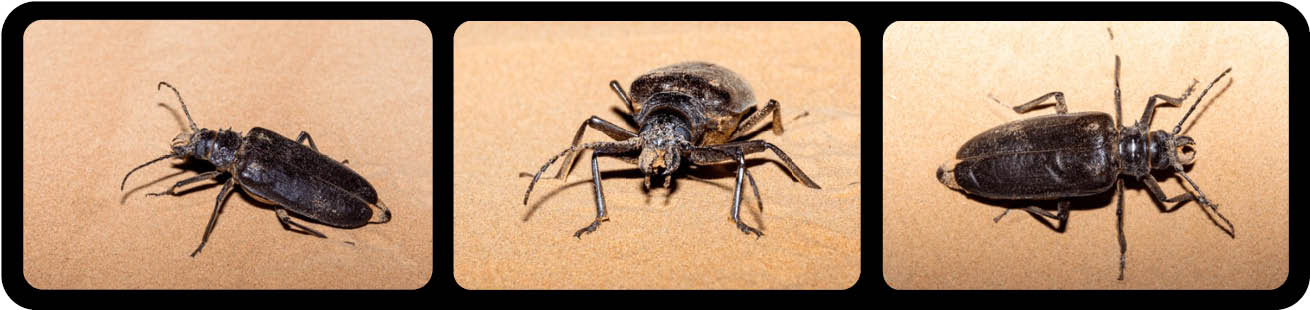
Anthracocentrus arabicus represents the largest longhorn beetle species native to the Arabian Peninsula and one of the most impressive cerambycid beetles in the broader Middle Eastern region. The species exhibits the robust, heavily sclerotized body plan characteristic of the genus Anthracocentrus, with distinctive morphological adaptations to arid and semi-arid environments. Wikipedia

Size and Dimensions
Adult specimens demonstrate moderate size variation with subtle sexual dimorphism:
- Body length (males): 45-70 mm (excluding mandibles)
- Body length (females): 50-75 mm (excluding mandibles)
- Maximum recorded length: Approximately 78 mm for exceptionally large females
- Body width: 18-28 mm at the widest point of elytra
- Mandible length: 8-15 mm depending on sex and individual variation
- Total weight: 8-15 grams for large specimens
Coloration
The species exhibits characteristic dark coloration:
- Overall: Deep black to brownish-black with a subtle metallic or coal-like sheen
- Elytra: Uniformly black, sometimes with very dark brown undertones
- Ventral surface: Black, often with slightly lighter brownish areas on abdominal sternites
- Appendages: Black to dark reddish-brown
- Mandibles: Dark reddish-brown to black
The common name “Anthracocentrus” derives from the Greek words for “coal” (anthrax) and “spine,” referencing both the dark coloration and the spined pronotum.
Subfamily Prioninae of the World I.
The Prionids of the World
The Prionids of the Neotropical Region
The Prionids Collection Bundle
Head and Mouthparts
The head is large, robust, and prognathous with strong deflection ventrally. The frons is broad, flattened to slightly convex, and densely punctate. Mandibles are stout, curved, and sexually dimorphic: males possess slightly longer, more curved mandibles with more pronounced apical teeth, while females have shorter, stouter mandibles with stronger basal teeth adapted for chewing wood. The inner margin of mandibles bears multiple teeth of varying sizes.
Compound Eyes: Large, strongly emarginate, nearly divided by antennal insertion, creating an almost figure-eight shape in frontal view. Eye facets are relatively coarse.
Antennae: Eleven-segmented, robust, inserted within the eye emargination:
- Males: Antennae reach to approximately middle of elytra or slightly beyond; segments 3-10 moderately serrate
- Females: Antennae shorter, reaching to approximately basal third of elytra; less strongly serrate
- Scape: Large, cylindrical, densely punctate
- Segments 3-10: Gradually decreasing in length toward apex, with serrate inner margin
- Terminal segment: Smaller, conical
Labrum: Transverse, anterior margin with dense golden-brown setae
Maxillary and Labial Palpi: Well-developed, terminal segments broadened, securiform
Thorax
Pronotum: Transverse, approximately 1.3-1.5 times broader than long, strongly convex in lateral view. Surface coarsely and densely punctate with irregular rugosities. Median longitudinal impression present but often weak or interrupted. Lateral margins armed with 3-4 acute spines on each side, the spines variable in development but typically well-defined. The anterior spine is usually the most prominent. Anterior margin with slight median projection between antennal bases. Posterior margin bisinuate.
Prosternum: Intercoxal process broad, slightly convex to flattened, coarsely punctate, with sparse golden pubescence.
Mesosternum: Short, intercoxal process narrow, triangular.
Metasternum: Large, strongly convex, very densely and coarsely punctate, with scattered recumbent golden setae particularly along median line.
Scutellum: Subtriangular to pentagonal, broader than long, with sparse pubescence, surface punctate.
Elytra
The elytra are elongate, robust, slightly convex, and completely cover the abdomen. Length approximately 2.5-3.0 times the pronotal length. Surface densely and coarsely punctate, particularly on basal half, with punctures becoming sparser and finer toward apex. Each elytron possesses 2-3 weak longitudinal costae (ridges), often obscured by dense punctation. These costae become more evident in lateral view.
Humeri: Prominent, well-developed, rounded
Lateral margins: Subparallel in basal two-thirds, then gradually converging to apex
Apex: Each elytron individually rounded to subtruncate, sometimes with minute sutural spine
Epipleuron: Distinct, broad basally, gradually narrowing posteriorly, extending to elytral apex
Surface vestiture: Sparse, short, recumbent golden to brownish setae, particularly evident in fresh specimens
Wings
Metathoracic wings are fully developed and functional. Wing venation typical of Prioninae. The species is capable of flight, though flight activity appears limited primarily to dispersal and mate-seeking during crepuscular hours.
Legs
All legs are robust and powerfully built, adapted for climbing and gripping wood substrates:
Femora: Strongly clavate (club-shaped), particularly the metafemora which are distinctly swollen in the apical half. Surface coarsely punctate with sparse setae.
Tibiae: Robust, cylindrical, slightly curved, particularly in metatibiae. Dorsal surface with longitudinal carina. Apical spurs present: 1-2-2 arrangement (protibiae-mesotibiae-metatibiae).
Tarsi: Formula 5-5-5. Tarsomeres broad, densely pubescent ventrally with golden setae. First three tarsomeres subequal in length. Fourth tarsomere deeply bilobed. Fifth tarsomere elongate with paired simple claws lacking basal teeth.
Coloration: Concolorous with body or slightly lighter reddish-brown on tarsi
Abdomen
The abdomen consists of five visible ventral sternites (urosternites). Sternites are densely and coarsely punctate with scattered recumbent golden setae. Punctation tends to be denser on lateral portions. The first visible sternite (actually fused sternites 1-2) is longest. The terminal (fifth) sternite is broadly rounded in females and slightly truncate or weakly emarginate in males. The pygidium is not exposed beyond elytral apices.
Sexual Dimorphism
Sexual dimorphism in A. arabicus is relatively subtle compared to some prionines:
Males:
- Slightly smaller average body size
- Longer, more curved mandibles
- Longer antennae (reaching to or beyond elytral midpoint)
- More strongly serrate antennal segments
- Narrower abdomen
- Terminal abdominal sternite weakly emarginate
Females:
- Larger, more robust body
- Shorter, stouter mandibles
- Shorter antennae (reaching to basal third of elytra)
- Broader, more convex abdomen
- Terminal abdominal sternite broadly rounded
Geographic Distribution
Anthracocentrus arabicus is endemic to the Arabian Peninsula, representing one of the characteristic megafauna beetles of this biogeographic region.
Country-level Distribution
Confirmed Records:
- Saudi Arabia: Western and southwestern regions (Asir, Makkah, Taif areas), central regions
- Yemen: Western mountains (Haraz Mountains, areas around Sana’a, Ta’izz)
- Oman: Northern mountains (Hajar Mountains, Jebel Akhdar region)
- United Arab Emirates: Northern emirates, particularly mountainous areas
Possible/Unconfirmed Records:
- Kuwait: Possible marginal occurrence
- Qatar: Unconfirmed reports
Habitat Distribution
The species shows distinct association with:
- Mountainous regions (500-2,500 m elevation)
- Wadis (seasonal watercourses) with arboreal vegetation
- Relic forest patches
- Areas with Acacia, Prosopis, Ziziphus, and other native woody vegetation
- Oases and areas with permanent or semi-permanent water
The distribution appears fragmented, corresponding to suitable habitat patches across the Arabian Peninsula’s heterogeneous landscape.
Biogeographic Significance
A. arabicus represents part of the distinctive Arabian endemic fauna, with biogeographic affinities to:
- African Prioninae (particularly East African forms)
- Southwest Asian xerophilous fauna
- Relictual elements from more humid past climates
Habitat and Ecology
Habitat Preferences
Anthracocentrus arabicus occupies a variety of semi-arid to arid habitats characterized by:
Vegetation Types:
- Acacia woodland and savanna
- Juniper (Juniperus spp.) stands at higher elevations
- Mixed thorn scrub
- Wadi vegetation with larger trees
- Date palm groves (Phoenix dactylifera)
- Relic montane forest patches
Climatic Conditions:
- Hot, dry summers (35-45°C peak temperatures)
- Mild to cool winters (5-20°C)
- Low annual precipitation (100-400 mm), concentrated in winter/spring
- Low relative humidity (typically 20-50%)
- Strong seasonal variation
Microhabitat:
- Large dead or dying trees, particularly in wadis
- Standing dead wood and large fallen branches
- Stumps of felled trees
- Occasionally in structural timber in traditional buildings
Life Cycle and Development
The life cycle of A. arabicus follows the typical prionine pattern with prolonged larval development adapted to the xeric environment and hard wood substrates.
Egg Stage
Oviposition: Females lay eggs individually or in small groups in bark crevices, splits in wood, or under loose bark of dead or dying trees. Oviposition typically occurs during the cooler months (October-March) following adult emergence.
Egg Description: Elongate-oval, approximately 4-6 mm in length, creamy-white to pale yellow, with a slightly roughened chorion.
Clutch Size: Estimated at 40-80 eggs per female based on dissections and observations.
Incubation Period: Approximately 3-4 weeks at optimal temperatures (20-25°C), potentially longer during cooler periods.
Larval Stage
The larval stage represents the longest portion of the life cycle, adapted to the challenging conditions of dry, hard wood in arid environments.
Duration: 2-4 years, variable depending on wood quality, temperature, and moisture availability. Development likely accelerated in moister microclimates and slower in extremely dry conditions.
Larval Morphology:
- Typical prionine form: elongate, cylindrical, slightly dorsoventrally flattened
- Creamy-white to yellowish coloration
- Head capsule brown, strongly sclerotized
- Thoracic segments slightly enlarged
- Legs reduced but present
- Mature larvae: 60-90 mm in length, 10-15 mm in width
Habitat: Larvae bore into dead wood of various hardwood species, creating extensive tunnel systems. They appear to prefer:
- Heartwood of dead trees
- Moderately to well-decayed wood
- Larger diameter wood (>15 cm diameter)
- Wood retaining some moisture
Feeding Behavior: Larvae consume decayed wood tissue, relying on gut microbiota to digest cellulose and lignin. Frass (powdered wood excrement) is compacted behind the larvae as they progress through galleries. Galleries are oval in cross-section, approximately 12-20 mm in diameter for mature larvae.
Development: Larvae pass through an estimated 7-10 instars, though precise instar number has not been definitively determined.
Pupal Stage
Pupation Site: Mature larvae construct pupal chambers within the wood substrate, typically 10-30 cm below the wood surface. The chamber is oval, approximately 60-80 mm long and 25-35 mm wide, oriented parallel to wood grain.
Prepupal Period: The final instar larva ceases feeding and undergoes a quiescent prepupal period of 1-2 weeks during which the gut is cleared.
Pupa Description:
- Type: Exarate (free appendages)
- Color: Initially pale creamy-white, gradually darkening to tan and then dark brown as adult cuticle develops
- Length: 45-65 mm
- Appendages (antennae, legs, mouthparts) clearly visible and free from body
Duration: 4-6 weeks depending on temperature
Phenology: Pupation appears synchronized, occurring primarily in late summer to early autumn (August-October), with adults emerging during the following cooler months.
Adult Stage
Emergence: Adults chew exit holes through the wood surface, creating characteristic oval to circular emergence holes 20-30 mm in diameter. Emergence is seasonal, occurring primarily during the cooler, wetter months (October-March), with peak emergence in November-January.
Adult Longevity: Estimated at 4-8 weeks based on field observations and captive specimens. Longevity may be extended in favorable microclimatic conditions.
Feeding: Adults appear to feed minimally or not at all. Some observations suggest occasional feeding on:
- Tree sap or exudates
- Moisture from damp wood or bark
- Possibly nectar from flowering plants
Adults rely primarily on energy reserves accumulated during larval development.
Activity Period: Adults are most active during cooler periods, with activity concentrated in late autumn through early spring.
Phenology
Seasonal Activity Pattern:
- October-March: Adult emergence and activity period; mating, dispersal, oviposition
- November-January: Peak adult abundance
- April-September: Larval development; no adult activity
- August-October: Pupation period
The phenology is tightly synchronized with the Arabian Peninsula’s climate, with adult activity avoiding the extreme summer heat.
Behavior
Activity Patterns
Diel Activity: Adults are primarily crepuscular and nocturnal:
- Activity begins at dusk
- Peak activity 1-3 hours after sunset
- Minimal or no activity during daylight
- During daytime: adults shelter in bark crevices, under rocks, or in ground debris
Temperature Dependence: Activity is strongly temperature-dependent:
- Activity threshold: approximately 15-18°C
- Optimal activity: 18-25°C
- Reduced activity above 30°C
- No activity above 35°C or below 12°C
Locomotion and Flight
Walking: Adults are slow but capable walkers, using powerful legs to navigate rough bark and wood surfaces.
Climbing: Well-adapted for vertical climbing on tree trunks using tarsal claws and grip strength.
Flight: Capable of sustained flight despite robust body:
- Flight primarily for dispersal from emergence sites
- Mate-location flights by males
- Flights typically brief (minutes) but can cover substantial distances
- Most flight activity during twilight hours
- Males appear more active fliers than females
Attraction to Light
Adults exhibit positive phototaxis and are attracted to artificial lights, though attraction appears weaker than in some other prionines. Attraction is most evident on warm, humid evenings during peak emergence periods. Light attraction has been exploited for survey and collection purposes.
Defensive Behavior
When threatened or handled, A. arabicus displays characteristic defensive responses:
Stridulation: Produces audible squeaking or hissing sounds by rubbing the posterior margin of the pronotum against the anterior margin of the mesonotum. This sound is clearly audible to humans and serves as an acoustic warning.
Biting: The powerful mandibles can deliver painful bites capable of breaking skin. Larger individuals should be handled with caution.
Leg Grasping: When picked up, beetles grip strongly with tarsal claws, making handling difficult.
Thanatosis: Some individuals feign death when disturbed, remaining motionless for extended periods.
Chemical Defense: No evidence of chemical defensive secretions.
Reproductive Behavior
Detailed observations of reproductive behavior in natural settings are limited:
Mate Location: Males likely locate females using pheromones, possibly emitted by calling females. Males may fly actively searching for females.
Courtship: Specific courtship behaviors not well documented. Males approach females and investigate with antennae.
Copulation: Mating occurs on tree trunks or branches. Duration of copulation not precisely documented but likely lasts several hours as in related species.
Oviposition Behavior: After mating, females search for suitable dead or dying wood for egg-laying. Females investigate wood substrate with antennae and mouthparts before ovipositing. Eggs are inserted into bark crevices or beneath loose bark using the extensible ovipositor.
Host Plants and Wood Substrate Preferences
While comprehensive host plant studies are limited, the following associations have been documented or suggested:
Confirmed or Probable Host Plants
Fabaceae (Legume Family):
- Acacia spp. (various species including A. tortilis, A. seyal, A. nilotica)
- Prosopis spp. (mesquite species, including introduced P. juliflora)
- Vachellia spp.
Rhamnaceae:
- Ziziphus spina-christi (Christ’s thorn jujube)
- Ziziphus spp.
Cupressaceae:
- Juniperus spp. (juniper) – particularly at higher elevations
Arecaceae:
- Phoenix dactylifera (date palm) – occasional records
Other Hardwoods:
- Various native and introduced hardwood species
- Possibly Tamarix spp. (tamarisk)
Wood Substrate Characteristics
Larvae show preference for:
- Dead or dying hardwood trees
- Trees in early to moderate stages of decay
- Larger diameter wood (>15 cm diameter preferred)
- Wood retaining moderate moisture content
- Heartwood rather than sapwood
The species appears to be a wood generalist within its habitat, utilizing various available hardwood substrates rather than showing strict host specificity.
Natural Enemies and Mortality Factors
Predators
Natural predators likely include:
Avian Predators:
- Woodpeckers (various species) may extract larvae from wood
- Shrikes and other insectivorous birds may prey on adults
- Owls potentially prey on night-active adults
Mammalian Predators:
- Bats may capture flying adults
- Small carnivores may occasionally consume adults
Reptilian Predators:
- Lizards (agamids, geckos) may prey on adults
- Snakes may occasionally consume adults
Parasites and Pathogens
Information on parasites and pathogens is very limited:
- Parasitic mites (Acari) occasionally observed on adults
- Fungal pathogens may affect larvae in moist wood
- Potential nematode parasitism of larvae (undocumented)
- Possible parasitoid wasps or flies (no confirmed records)
Abiotic Mortality Factors
Extreme Heat: Summer temperatures exceeding 45-50°C may cause mortality, particularly in exposed wood
Desiccation: Extreme drought may dry wood substrates, killing developing larvae
Flash Floods: Wadis subject to flash flooding may drown larvae in submerged wood
Fire: Wildfires (though rare in the region) would destroy populations in affected areas
Ecological Role
A. arabicus fulfills several ecological functions:
Nutrient Cycling: Larvae accelerate decomposition of dead wood, facilitating nutrient release and soil formation in resource-limited arid environments
Habitat Engineer: Larval galleries create microhabitats utilized by other invertebrates, small reptiles, and arthropods
Food Web Component: Adults and larvae serve as prey for various predators
Indicator Species: Presence indicates availability of dead wood and relatively intact native vegetation, potentially serving as a bioindicator for habitat quality
Conservation Status
Current Assessment
Anthracocentrus arabicus has not been formally assessed by the IUCN Red List, representing a significant knowledge gap for Arabian Peninsula biodiversity conservation.
Threat Analysis
Several factors warrant conservation concern:
Habitat Loss and Degradation
Deforestation: Removal of native woody vegetation for:
- Firewood collection
- Charcoal production
- Agricultural expansion
- Urban development
- Infrastructure projects
Overgrazing: Excessive livestock grazing prevents regeneration of woody vegetation, eliminating future dead wood resources
Water Extraction: Groundwater pumping and dam construction reduce wadi flow, affecting tree health and survival
Invasive Species: Introduction of exotic plants may alter habitat structure and composition
Climate Change
Temperature Increase: Rising temperatures may:
- Exceed thermal tolerance limits
- Increase larval mortality in wood substrates
- Alter phenology and life cycle synchronization
Precipitation Changes: Decreased rainfall may:
- Reduce suitable habitat extent
- Increase tree mortality beyond levels supporting beetle populations
- Dry wood substrates excessively
Extreme Weather: Increased frequency of extreme events (droughts, floods) may impact populations
Collection Pressure
Scientific Collecting: Specimens valued for scientific collections and private collectors
Commercial Trade: Some demand in international insect trade, though less than for larger tropical species
Impact Assessment: Currently likely minimal but could increase with improved access to remote areas
Limited Distribution and Small Population Size
Endemic Status: Restriction to Arabian Peninsula creates vulnerability
Habitat Fragmentation: Suitable habitat exists in isolated patches, limiting population connectivity
Small Population Size: Each suitable habitat patch likely supports relatively small populations
Genetic Concerns: Fragmentation may lead to genetic isolation and reduced diversity
Population Status
Abundance: Population density appears naturally low, with scattered distribution corresponding to suitable dead wood availability
Trends: No systematic monitoring exists; trends unknown but likely declining based on habitat loss
Distribution Changes: Probable range contraction due to habitat degradation, though historical baseline lacking
Conservation Recommendations
Research Priorities
- Distribution Surveys: Systematic surveys across Arabian Peninsula to map current distribution
- Population Monitoring: Establish monitoring sites to assess population trends
- Life History Studies: Detailed studies of development time, host preferences, and ecology
- Genetic Assessment: Population genetics to assess connectivity and diversity
- Climate Modeling: Predict impacts of climate change on suitable habitat
Conservation Actions
- Habitat Protection:
- Protect wadi systems and relic forest patches
- Establish or expand protected areas containing populations
- Implement sustainable grazing management
- Dead Wood Management:
- Retain dead and dying trees in managed landscapes
- Promote natural regeneration of native woody species
- Create awareness of dead wood ecological importance
- Sustainable Use:
- Develop guidelines for sustainable scientific collecting
- Monitor and regulate commercial trade if necessary
- Engage local communities in conservation
- Ex-situ Conservation:
- Explore captive breeding possibilities
- Maintain reference collections in museums
- Legal Protection:
- Assess need for legal protection status
- Include in national biodiversity strategies
- International Cooperation:
- Coordinate conservation across countries in species’ range
- Share data and resources
- Education and Awareness:
- Raise public awareness of Arabian endemic species
- Engage local communities as stakeholders
- Develop educational materials
Research History and Taxonomy
Discovery and Description
Anthracocentrus arabicus was formally described by Gianfranco Sama in 1994, relatively recently compared to many prionine species. The holotype was collected in Saudi Arabia. The description filled a gap in knowledge of Arabian Peninsula cerambycid fauna and represented an important discovery of a distinctive large beetle endemic to the region.
Taxonomic Position
Genus Anthracocentrus:
The genus Anthracocentrus White, 1853 contains several species distributed across Africa and the Arabian Peninsula:
- A. arabicus Sama, 1994 – Arabian Peninsula (largest species in genus)
- A. brachypterus (Thomson, 1860) – East Africa
- A. gabrielae Sama, 2008 – Ethiopia
- A. rufoplagiatus (Waterhouse, 1882) – East and Southern Africa
- Several other species and subspecies
The genus is characterized by:
- Large, robust body
- Dark coloration (often black or very dark brown)
- Strongly spined pronotum
- Coarsely punctate surface sculpture
- Association with arid to semi-arid environments
Tribe Macrotomini:
Anthracocentrus belongs to Macrotomini, a tribe of Prioninae containing many large-bodied genera distributed primarily in the Old World tropics and subtropics. Macrotomini is characterized by:
- Large to very large body size
- Mandibles with multiple teeth
- Pronotum typically with lateral spines
- Adults generally non-feeding or minimal feeders
Taxonomic Uncertainty and Related Issues
Species Boundaries: Some uncertainty exists regarding species limits within Anthracocentrus, with possible undescribed diversity or subspecific variation. Molecular phylogenetic studies would help clarify relationships.
Subspecies: No subspecies currently recognized for A. arabicus, though geographic variation across the Arabian Peninsula has not been thoroughly studied.
Synonymy: No known synonyms for A. arabicus.
Type Material
Holotype: Deposited in scientific collection (specific repository should be verified from original description)
Type Locality: Saudi Arabia (specific locality details in original description)
Paratypes: Additional specimens designated as paratypes from the type series
Recent Research and Publications
Research on A. arabicus has been limited, with most information appearing in:
- Faunistic surveys of Arabian Peninsula Coleoptera
- Taxonomic revisions of Anthracocentrus
- General works on Middle Eastern cerambycids
- Museum collection catalogs
Significant knowledge gaps persist regarding all aspects of biology and ecology.
Comparative Biology
Comparison with Congeners
vs. Anthracocentrus brachypterus (East Africa):
- A. arabicus larger (up to 78mm vs. typically 50-60mm)
- Different geographic range (Arabian vs. East African)
- Similar ecology but in different biomes
vs. Anthracocentrus gabrielae (Ethiopia):
- Similar size range
- Overlapping biogeographic affinities
- Both montane specialists in arid regions
Comparison with Other Arabian Prioninae
Other Prioninae recorded from the Arabian Peninsula include smaller species in genera such as:
- Prinobius spp.
- Various smaller prionines
A. arabicus represents the largest prionine and one of the largest beetles of the Arabian Peninsula.
Adaptations to Arid Environments
Compared to tropical prionines, A. arabicus shows several adaptations:
Phenology: Adult activity during cooler, moister months avoids extreme summer heat
Substrate Use: Utilization of hard, dry wood substrates characteristic of arid-zone trees
Development Rate: Potentially variable development rate responding to substrate moisture and temperature
Water Conservation: Dark coloration may reduce water loss; behavioral thermoregulation limits heat exposure
Host Breadth: Generalist wood-boring in various available hardwoods reflects resource limitation in arid environments
Cultural and Economic Aspects
Traditional Knowledge and Cultural Significance
Information on traditional knowledge or cultural significance among Arabian peoples is limited in scientific literature. The beetle’s large size likely makes it known to people who utilize or observe native vegetation, though specific cultural references or traditional names require further documentation.
Economic Considerations
Positive Economic Aspects:
- Scientific and educational value for Arabian biodiversity
- Potential ecotourism interest as flagship species
- Indicator of forest health and ecosystem integrity
Negative Economic Impacts:
- Minimal to none; species colonizes already dead wood
- Not a pest of living trees or structural timber
- No agricultural significance
Commercial Trade:
- Limited demand in insect specimen trade
- Specimens occasionally offered for sale ($50-150 depending on size and condition)
- Low collection pressure currently
Conservation Economics
Value for Conservation:
- Flagship species for Arabian Peninsula forest conservation
- Charismatic megafauna that could attract conservation support
- Educational ambassador for regional biodiversity
Cost-Benefit:
- Low-cost conservation through habitat protection
- Benefits extend to broader ecosystem conservation
Captive Rearing and Husbandry
Information on captive rearing is extremely limited, with few documented attempts.
Collection and Maintenance of Adults
Collection Methods:
- Light traps during emergence season (UV or mercury vapor)
- Direct search in suitable habitat at dusk/night
- Emergence trap sampling over dead wood
Adult Housing:
- Large terrarium with bark substrate
- Temperature: 18-25°C
- Humidity: 30-50% RH
- Provide moisture source (damp substrate area)
- Vertical bark pieces for climbing
Adult Feeding:
- Minimal or no feeding required
- Offer sugar water, fruit, or tree sap
- Ensure moisture availability
Breeding Attempts
Mating:
- House pairs together in large container
- Provide optimal temperature (20-24°C)
- Observe for mating behavior
- Copulation may last several hours
Oviposition:
- Provide dead wood pieces (preferred host species)
- Wood should be moderately decayed
- Maintain moderate moisture
- Monitor for eggs in bark crevices
Larval Rearing
Substrate:
- Dead hardwood (Acacia, Prosopis, or similar)
- Wood in early to moderate decay
- Maintain appropriate moisture (not too dry or wet)
Conditions:
- Temperature: 20-28°C (with seasonal variation)
- Humidity: 50-70% RH
- Long development time (2-4 years)
Challenges:
- Multi-year rearing period
- Maintaining appropriate substrate
- Avoiding fungal overgrowth
- Providing optimal moisture balance
- High investment for uncertain success
Ex-situ Conservation Potential
Captive breeding could serve conservation purposes but faces challenges:
- Long generation time limits breeding program feasibility
- Substrate requirements may be difficult to maintain
- Limited knowledge of optimal rearing conditions
- Better to focus on habitat conservation
Collection and Curation
Ethical and Legal Considerations
Permits:
- Verify country-specific regulations before collecting
- Obtain necessary permits from Saudi Arabia, Yemen, Oman, UAE authorities
- Follow CITES regulations if applicable (currently not listed)
Sustainable Collection:
- Avoid over-collecting from single sites
- Limit collection to scientific necessity
- Consider population status before collecting
- Document all collection data thoroughly
Cultural Sensitivity:
- Respect local customs and property rights
- Engage local communities when collecting
- Provide benefits to local people where possible
Field Collecting Methodology
Survey Methods:
Light Trapping:
- Use UV or mercury vapor lights
- Set up at dusk in suitable habitat
- Operate for 2-4 hours after sunset
- Most effective November-January
- Position near wadi systems or relic forests
Active Searching:
- Search dead and dying trees for emergence holes
- Check bark crevices for sheltering adults during day
- Monitor emergence sites during appropriate season
- Use headlamps for nocturnal searching
Emergence Traps:
- Place mesh traps over suitable dead wood
- Check traps regularly during emergence season
- Non-destructive monitoring method
Documentation:
- Record GPS coordinates
- Document habitat characteristics
- Photograph specimens and habitat
- Note associated species
- Record weather conditions and temperature