Rhino Beetle Species (Dynastinae):
A Comprehensive Species Guide
Taxonomic Position: Order Coleoptera, Family Scarabaeidae, Subfamily Dynastinae
Common Names: Rhinoceros beetles, Hercules beetles, Elephant beetles, Horn beetles
Species Diversity: Approximately 1,500 described species in over 225 genera
Notable Genera: Dynastes, Megasoma, Chalcosoma, Oryctes
Size Range: 25 mm to over 170 mm (including horns)
Wikipedia
Main Features: Diversity Across Species
The subfamily Dynastinae encompasses extraordinary diversity in size, horn morphology, coloration, and ecological adaptations. While all rhinoceros beetles share the fundamental characteristic of males bearing horns or horn-like projections, the spectacular variation among species creates one of the most diverse groups within Coleoptera. This diversity reflects evolutionary radiations in response to varied environmental conditions, host plant associations, and sexual selection pressures across the beetles’ global distribution.

Book novelties:
Prioninae of the World I.
Cerambycidae of the Western Paleartic I.
Major Species Groups and Representatives
Understanding rhinoceros beetle diversity requires familiarity with major genera and representative species that exemplify the group’s remarkable variation:
Genus Dynastes – The Hercules Beetles
Dynastes hercules (Hercules beetle): Perhaps the most famous rhinoceros beetle, this Neotropical species is among the longest beetles in the world, with males reaching total lengths exceeding 170 mm including the spectacular forward-projecting cephalic horn and upward-curving pronotal horn. The elytra are typically yellowish-green to olive with variable black markings, creating a distinctive appearance. The horns, which can exceed half the total body length, are covered with short, dense setae giving a velvety texture. Found from southern Mexico through Central America to northern South America, including Caribbean islands, this species inhabits tropical and subtropical montane forests.
Dynastes tityus (Eastern Hercules beetle): Native to the eastern United States, this species is smaller than its tropical relative but still impressive, with males reaching 40-60 mm. The elytra are greenish-gray to tan with variable black spotting. Males possess both cephalic and pronotal horns, though proportionally shorter than in D. hercules. This species is common in deciduous forests and frequently attracted to lights during summer months.
Dynastes granti (Grant’s rhinoceros beetle): Occurring in the southwestern United States and Mexico, this species shows adaptation to more arid conditions than other Dynastes. Males have relatively short, robust horns and plain brown to tan elytra without prominent markings.
Other Dynastes species occur in various regions of the Americas, each with distinctive horn morphology and coloration patterns reflecting local evolutionary histories.
Genus Megasoma – The Elephant Beetles
Megasoma elephas (Elephant beetle): One of the heaviest beetles in the world, with larvae reaching masses exceeding 100 grams. Adult males are massive, robust beetles with thick, elephantine bodies and three prominent horns: a long forward-projecting cephalic horn and two shorter pronotal horns. The elytra are black or dark brown, often with a grayish pubescence. Distribution includes Mexico through Central America. Despite their bulk, adults are capable fliers and are attracted to lights.
Megasoma actaeon (Actaeon beetle): A South American species rivaling M. elephas in size and mass. Males have similar three-horned configuration but with proportionally stouter horns. The species occurs in tropical forests of the Amazon basin and adjacent regions.
Megasoma mars: Another large Central American species with distinctive horn morphology including a broad, flattened cephalic horn.
The genus Megasoma represents the upper limit of insect size, with species in this genus among the heaviest insects on Earth.
Genus Chalcosoma – The Atlas Beetles
Chalcosoma atlas (Atlas beetle): A spectacular Southeast Asian species with males reaching 100-130 mm including horns. The horn configuration includes a long, curved cephalic horn and two pronotal horns, creating a three-horned appearance. The body is black with a greenish or bronzy metallic sheen. This species occurs in rainforests from Thailand and Malaysia through Indonesia, with several subspecies recognized across its range.
Chalcosoma caucasus (Caucasus beetle): Another large Asian species with similar horn configuration but different proportions and coloration details. The cephalic horn is particularly long and may exceed body length in large males.
Chalcosoma chiron: A third major species in the genus, occurring across parts of Southeast Asia with distinctive horn shapes differentiating it from congeners.
These species are popular in beetle fighting traditions in parts of Asia and are commonly bred in captivity.
Genus Oryctes – The Smaller Rhinoceros Beetles
Oryctes rhinoceros (Coconut rhinoceros beetle): A medium-sized species (males 35-50 mm) with a single prominent cephalic horn that curves backward. The body is uniformly dark brown to black. This species has enormous economic importance as a pest of coconut and oil palms throughout its range in the Indo-Pacific region. Adults bore into palm crowns, causing damage that can kill trees. The species has been accidentally introduced to numerous Pacific islands where it was not native, causing significant agricultural and ecological damage.
Oryctes nasicornis (European rhinoceros beetle): Occurring across Europe, North Africa, and parts of Asia, this species is smaller than tropical relatives (males 20-40 mm) with a relatively short, backward-curving cephalic horn. The body is reddish-brown to black. Despite its smaller size, it is an impressive beetle and culturally significant as one of few large beetles in Europe.
The genus Oryctes includes numerous species distributed across the Old World tropics, with many species showing similar morphology of a single backward-curving horn.
Genus Golofa – The Long-Horned Beetles
Golofa porteri: Neotropical species with males bearing extremely long, forward-projecting cephalic horns that may be nearly as long as the entire body. The horn is relatively slender and elegant compared to the more massive structures in Dynastes or Megasoma. The body is black or dark brown with a smooth, shining surface.
Other Golofa species occur in montane forests of Central and South America, with several species showing similar elongate horn morphology.
Genus Xylotrupes – Asian and Pacific Rhinoceros Beetles
Xylotrupes gideon: A widespread species across Southeast Asia and the Pacific, with males reaching 40-60 mm. The horn configuration consists of a large, forward-projecting cephalic horn and smaller pronotal horn. Coloration is typically black or dark brown. This species is common in both natural and agricultural areas and is frequently attracted to lights.
Xylotrupes ulysses: An Australian relative with similar appearance but distinctive horn proportions and geographic distribution restricted to Australia and New Guinea.
Horn Morphology Variation
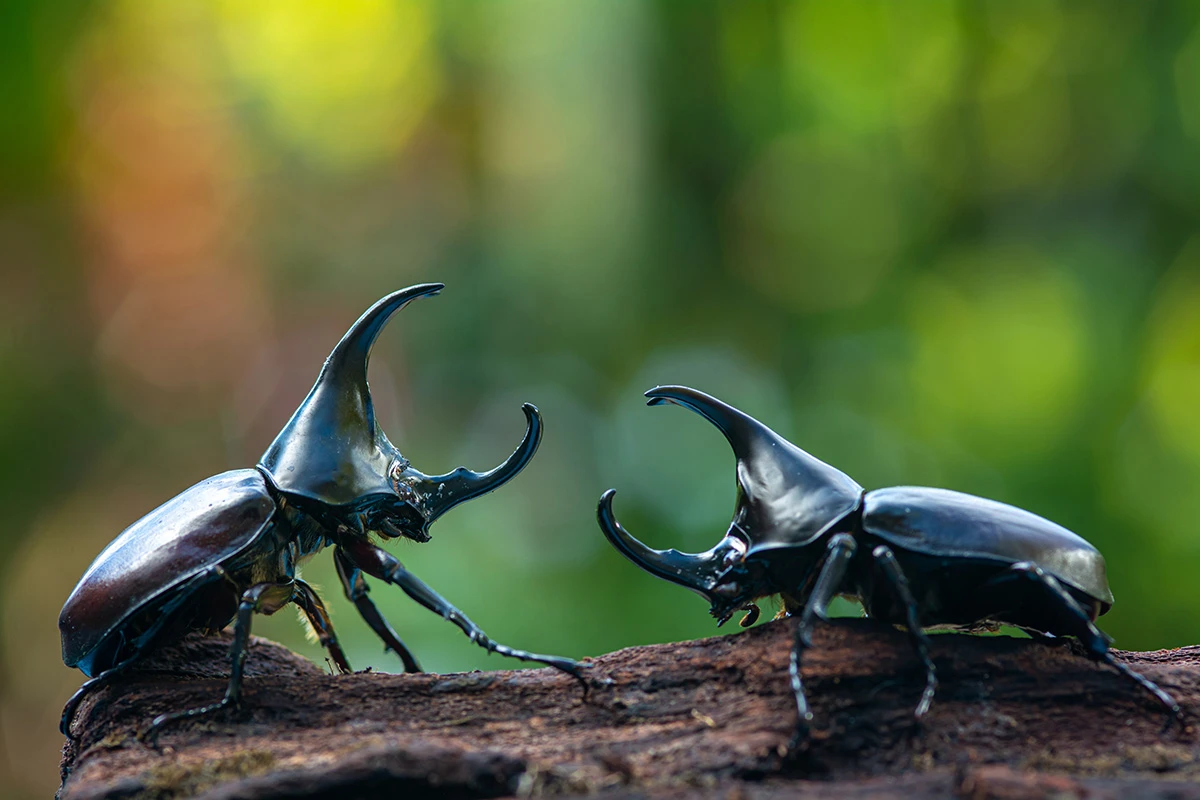
The spectacular diversity in horn morphology across rhinoceros beetle species represents different solutions to the common problem of male-male competition. Horn configurations include:
- Single cephalic horns: Backward-curving structures typical of Oryctes and relatives
- Paired horn systems: Cephalic and pronotal horns working in opposition, as in Dynastes and Chalcosoma
- Multiple pronotal horns: Complex multi-horned structures creating elaborate head-and-pronotum weapons
- Elongate slender horns: Long, elegant projections in genera like Golofa
- Short, robust horns: Powerful but proportionally shorter structures in some species
Horn size shows positive allometry, with larger males bearing disproportionately larger horns. This creates dramatic size variation within species, with small males having relatively modest horns while large males possess spectacular structures.
Color and Pattern Variation
While many rhinoceros beetles are uniform black or brown, spectacular exceptions exist. Dynastes species often have colored elytra with complex black markings. Some species show metallic sheens ranging from greenish to bronzy to purplish. Sexual dichromatism is minimal, though females of species with brightly colored males may show similar but often duller patterns.
How to Identify Rhinoceros Beetle Species
Identifying rhinoceros beetles to species level requires attention to multiple characters, with geographic location often providing crucial context.
Key Identification Characters
| Character | Taxonomic Importance | Variation |
|---|---|---|
| Horn morphology | Primary species character | Shape, length, number, orientation, surface texture |
| Body size | Genus and species level | 10-170+ mm total length including horns |
| Coloration | Species-specific in some groups | Black, brown, colored, metallic, patterned |
| Elytral sculpture | Species identification | Smooth, punctate, striate, pubescent |
| Geographic location | Essential for identification | Many species regionally restricted |
| Habitat type | Supporting character | Forest type, elevation, vegetation |
Regional Identification Guides
North America: Relatively few species simplify identification. Dynastes species (large with paired horns), various Strategus species (medium-sized with three pronotal horns), Xyloryctes species (moderate size with single horn), and several smaller genera.
Central and South America: High diversity requires careful attention to horn details and coloration. Dynastes, Megasoma, Golofa, and numerous other genera with diverse species.
Asia: Chalcosoma, Oryctes, Xylotrupes, Allomyrina, and many others. Identification often requires subspecies-level determination within widespread species complexes.
Africa: Oryctes and various other genera, generally less spectacular than Asian or Neotropical species but diverse.
Australia and Pacific: Xylotrupes, various Oryctes species, and endemic genera.
Sexual Dimorphism Recognition
Females typically lack horns entirely or possess only small tubercles in positions corresponding to male horns. Female body form is more smoothly rounded without the angular structures males develop to support horns. Females are often difficult to identify to species without associated males, requiring detailed examination of genital structures or other subtle characters.
Occurrence and Main Habitats
Rhinoceros beetle species occupy diverse habitats across their global distribution, with habitat preferences varying among species based on larval substrate requirements and adult ecology.
Tropical Rainforests
The greatest diversity occurs in tropical rainforests, where warm, humid conditions and abundant decaying wood support rich assemblages. Species like Dynastes hercules, Megasoma elephas, and Chalcosoma atlas inhabit lowland and montane rainforests. The structural complexity of tropical forests, diverse tree species, and continuous warm temperatures create optimal conditions for large-bodied species with extended larval development.
Temperate Forests
Temperate regions support fewer species but locally abundant populations. Dynastes tityus in eastern North American deciduous forests, Oryctes nasicornis in European woodlands, and various Asian species in temperate forests exemplify adaptation to seasonal climates with cold winters requiring overwintering strategies.
Agricultural Landscapes
Several species, particularly in genus Oryctes, have adapted to agricultural environments. The coconut rhinoceros beetle thrives in palm plantations, while other species utilize compost, manure, and agricultural waste as larval substrate. This adaptation makes some species pests but also allows persistence in modified landscapes.
Elevational Distributions
Some species show restricted elevational ranges. Montane species like some Dynastes and Golofa occur primarily at middle to high elevations in tropical mountains, while others are lowland specialists. Elevational gradients create turnover in species composition reflecting thermal and vegetation changes.
Lifestyle and Behavior
Rhinoceros beetle behavior varies among species but common patterns reflect their ecology as decomposers with adults emerging for brief reproductive periods.
Activity Patterns
Most species are nocturnal, with adults emerging at dusk to feed, mate, and disperse. Flight activity peaks during warm, humid evening hours. Species differ in flight readiness, with some being strong, sustained fliers while others fly reluctantly. Many species are attracted to lights, creating opportunities for observation and study but also causing problems when beetles collide with windows, vehicles, or people.
A few species show diurnal activity patterns, particularly in cooler climates where daytime temperatures may be necessary for activity.
Combat and Male Competition
Male-male combat for access to females and resources has been extensively studied in several species. Combat patterns vary with horn morphology:
Dynastes and Chalcosoma species with paired horns use these to grasp opponents, lift them, and attempt to throw them from branches or other substrates. Combat is vigorous but rarely causes serious injury, with losers typically retreating intact.
Species with single horns show different combat tactics, using horns to push, pry, and lever opponents. The horns function as levers with fights resembling wrestling matches.
Horn size correlates with fighting success, with larger-horned males generally winning encounters. However, fighting ability involves multiple factors including strength, tactics, and motivation, not solely horn size.
Mating Behavior
Mating typically occurs at feeding sites where both sexes aggregate. Males may defend territories at sap flows or rotting fruit concentrations, attempting to mate with visiting females. Male guarding of females after copulation occurs in some species, presumably to prevent rival males from displacing the guarding male’s sperm.
Copulation duration ranges from minutes to hours depending on species. Multiple matings by both males and females occur in many species, creating sperm competition dynamics.
Dispersal and Flight
Despite massive size and seemingly ungainly proportions, most rhinoceros beetles are capable fliers. Large species generate audible buzzing sounds during flight due to rapid wing beats. Flight allows colonization of new habitats and location of mates and oviposition sites dispersed across landscapes.
Dispersal distances vary, but mark-recapture studies of some species have documented movements of several kilometers, indicating substantial dispersal capability.
Food and Role in the Ecosystem
Rhinoceros beetles fulfill important ecological roles through larval decomposition activities and adult feeding behaviors, with impacts varying among species and ecosystems.
Larval Feeding Ecology by Species
Different species show preferences for different larval substrates:
Dynastes species: Larvae develop in decaying hardwood logs, particularly advanced decay stages where fungal action has softened wood. Different Dynastes species may prefer particular tree species or decay conditions.
Megasoma species: Larvae require very large logs or stumps given their enormous size. Development occurs over 2-3 years in advanced decay stages of large-diameter hardwoods.
Oryctes species: Many species are less specific, utilizing decaying palm trunks, compost heaps, manure piles, sawdust accumulations, and various organic substrates. This flexibility allows adaptation to agricultural environments.
Chalcosoma and Xylotrupes species: Develop in rotting logs and tree stumps in tropical forests, with larvae of large species requiring substantial wood volumes.
Adult Feeding by Species
Sap-feeding specialists: Dynastes hercules and related species feed primarily at tree sap flows, sometimes creating or enlarging wounds to induce sap production.
Fruit-feeders: Some species, including various Megasoma species, prefer rotting fruit when available.
Plant-tissue feeders: Oryctes rhinoceros bores into palm crowns to feed on tender growing tissues, behavior that causes crop damage.
Minimal feeders: Some species have reduced mouthparts and apparently feed minimally as adults, relying primarily on larval-accumulated resources.
Ecosystem Services and Impacts
Beneficial roles include accelerating dead wood decomposition, creating microhabitats through tunneling, and serving as prey for vertebrate predators. Negative impacts occur when pest species damage crops or when invasive species harm novel ecosystems.
Life Cycle
Life cycles show general similarities across species but differ in duration and details.
Development Duration by Species
| Species/Group | Typical Development Time | Comments |
|---|---|---|
| Dynastes hercules | 18-24 months | Extended development due to large size |
| Megasoma species | 24-36+ months | Longest development among rhinoceros beetles |
| Chalcosoma species | 12-18 months | Faster than similar-sized Neotropical species |
| Oryctes rhinoceros | 6-9 months | Relatively rapid development |
| Dynastes tityus | 12-18 months | Includes winter diapause |
Size-Dependent Development
Within species, individuals destined to become large adults with impressive horns require longer development periods and more food than those becoming smaller adults. This creates substantial variation in development time even within single species and cohorts.
Adult Longevity by Species
Adult lifespans generally range from several weeks to several months. Large tropical species may survive 3-6 months under favorable conditions, while temperate species often live 2-4 months. Captive individuals may survive longer than wild adults given protection from predation and reliable food.
Bionomics – Mode of Life
Temperature and Humidity Requirements
Tropical species require consistent warmth and high humidity, with development ceasing or slowing dramatically at cooler temperatures. Temperate species tolerate seasonal temperature variation through overwintering as larvae or adults with cold-hardy stages.
Optimal temperatures for larval development typically range from 20-28°C depending on species, with tropical species at the upper end and temperate species showing broader tolerance. Humidity requirements are generally high, with larvae requiring moist substrates and adults needing humid air to prevent desiccation.
Substrate Quality Effects
Wood quality, decay stage, fungal colonization, moisture content, and wood species all influence larval development success and final adult size. High-quality substrates produce larger adults with more impressive horns, while poor substrates result in smaller adults with reduced secondary sexual characters. Understanding these relationships is crucial for captive breeding efforts.
Natural Enemies
Larvae face predation from various mammals that excavate them from rotting wood, birds including woodpeckers, and predaceous beetle larvae. Adults are preyed upon by bats, birds, and various predators. Parasitoid flies and wasps attack some species. Fungal and bacterial pathogens cause disease in both larvae and adults.
Distribution
Major Species Ranges
Dynastes hercules: Discontinuous distribution from southern Mexico through Central America, Colombia, Venezuela, Ecuador, Peru, Bolivia, Caribbean islands. Subspecies recognized across range.
Megasoma elephas: Mexico through Central America in montane forests.
Chalcosoma atlas: Southeast Asia from Myanmar and Thailand through Malaysia and Indonesia, with several recognized subspecies.
Oryctes rhinoceros: Originally native to tropical Asia, now introduced across Pacific islands creating expanded range through human activity.
Dynastes tityus: Eastern United States from New York to Texas, most common in southeastern states.
Endemism and Range Restrictions
Many species have restricted ranges limited to particular islands, mountain ranges, or regions. Island endemics are particularly common, with species confined to single islands or island groups in the Caribbean, Pacific, and Indian Ocean regions.
Invasive Species
The coconut rhinoceros beetle has been accidentally introduced to numerous Pacific islands through transport of infested plant materials, establishing populations that cause agricultural damage. Preventing further spread requires strict quarantine and inspection of potentially infested materials.
Records and Interesting Facts
Size and Strength Records
Longest Beetle: Dynastes hercules males including horns can exceed 170 mm total length, making this one of the longest beetles in the world. The massive forward-projecting cephalic horn contributes substantially to total length.
Heaviest Beetles: Megasoma larvae reach masses exceeding 100 grams, making them among the heaviest insect larvae. Adult beetles of this genus, while lighter than final-instar larvae, still rank among the heaviest beetles.
Proportional Strength: Rhinoceros beetles can lift approximately 850 times their own body weight, making them among the strongest animals relative to size. This extraordinary strength results from the powerful muscles required for combat and the mechanical advantages provided by their robust build.
Longest Horns: Males of some Dynastes and Golofa species have horns approaching or exceeding body length, creating total lengths more than double the body proper.
Cultural Significance and Human Interactions
Beetle Fighting: In parts of Asia, particularly Japan and Thailand, rhinoceros beetle fighting is a traditional sport and gambling activity. Beetles are collected or bred for competition, with males placed together to fight. Chalcosoma, Xylotrupes, and Allomyrina species are particularly popular for this purpose. The sport has ancient roots and continues as both traditional practice and commercial activity.
Pet Trade: Large, impressive species like Dynastes hercules and Chalcosoma atlas are popular in the international pet trade. Captive breeding supplies much of this demand, reducing pressure on wild populations, though illegal collection still threatens some populations. Proper permits are required for international trade in many species.
Cultural Symbolism: Rhinoceros beetles feature in folklore, art, and popular culture across their ranges. In Japan, Allomyrina dichotoma is culturally significant, appearing in artwork and stories. The beetles’ impressive horns and strength make them natural symbols of power and determination.
Traditional Medicine: In some cultures, rhinoceros beetles are used in traditional medicine, though efficacy is unproven and collection for this purpose may threaten populations.
Scientific and Research Contributions
Biomechanics Research: Rhinoceros beetle horns and combat have been studied extensively to understand sexual selection, biomechanics of weaponry, and evolution of exaggerated traits. These studies have broad implications for understanding how reproductive competition shapes morphology.
Developmental Biology: Research on horn development has revealed the endocrine mechanisms controlling alternative male morphologies, contributing to understanding of phenotypic plasticity and development. These findings have relevance beyond beetles to broader understanding of how organisms produce different forms based on environmental conditions.
Strength and Materials: The extraordinary strength of rhinoceros beetles has inspired biomimetic research, with engineers studying beetle exoskeleton structure and muscle organization to inform design of strong, lightweight materials and structures.
Model Organisms: Several species have become model systems for studying topics including sexual selection, developmental plasticity, and insect-microbe symbioses. The impressive phenotypes and tractable biology make rhinoceros beetles valuable research subjects.
Notable Species Records
Altitude Record: Some Dynastes and Golofa species occur in montane forests at elevations exceeding 3,000 meters, demonstrating adaptation to cool, high-elevation conditions unusual for large tropical beetles.
Longevity Record: While most species live weeks to months as adults, captive individuals of large species have survived over a year, though this is exceptional.
Fecundity: Female rhinoceros beetles can produce substantial numbers of eggs, with large species potentially laying 50-100+ eggs over their lifetimes, though exact numbers vary with species, female size, and nutrition.
Speed Records: Despite massive size, flying rhinoceros beetles can achieve speeds of 10-15 kilometers per hour, impressive for insects of such bulk.
Conservation Status and Threats
Several rhinoceros beetle species face conservation concerns due to habitat loss, over-collection, and other threats:
Habitat Loss: Deforestation eliminates the dead wood essential for larval development. Species requiring old-growth forests with large-diameter dead wood are particularly threatened. Montane species face threats from forest conversion and climate change affecting upland habitats.
Collection Pressure: Popular species in the pet trade face collection pressure, though captive breeding has reduced impacts in some cases. Illegal collection for commercial trade threatens some populations, particularly of large, spectacular species.
Climate Change: Shifting thermal and precipitation regimes may affect species with narrow climatic tolerances. Montane species may face “mountaintop extinction” as suitable climatic zones shift upward.
Invasive Pests: The coconut rhinoceros beetle causes significant agricultural damage in introduced ranges and threatens island ecosystems. Biological control using the Oryctes nudivirus has shown promise but requires continued management.
Conservation strategies include habitat protection, regulation of trade, captive breeding programs, and research on population status and trends.
Unusual and Extreme Adaptations
Temperature Tolerance: Some desert-adapted species tolerate extreme heat, with adults active on surfaces that would quickly kill many insects.
Stridulation: Many species produce sounds by rubbing body parts together when threatened, creating squeaking or hissing noises. These sounds may deter predators or signal to conspecifics.
Color Change: The elytra of Dynastes hercules change color with humidity, appearing more yellowish when dry and darker when humid. This reversible color change results from optical properties of the elytral cuticle responding to moisture.
Polymorphism: The dramatic size-dependent horn polymorphism creates spectacular variation within species, with small males resembling different species from large males of the same population.
Conclusion
Rhinoceros beetles represent extraordinary diversity within the subfamily Dynastinae, with species ranging from modest beetles of a few centimeters to massive insects ranking among the largest and heaviest in the world. The spectacular horns, remarkable strength, and impressive size of many species have captured human imagination across cultures and throughout history, making these beetles among the most recognizable and celebrated insects.
The diversity of species reflects evolutionary radiations across varied habitats and environmental conditions, with different species adapting to tropical rainforests, temperate woodlands, arid regions, and modified landscapes. Understanding this diversity requires appreciation of both the common features uniting the group and the distinctive characteristics distinguishing individual species.
From ecological perspectives, rhinoceros beetles contribute importantly to nutrient cycling and energy flow through their roles as decomposers and prey. The pest status of some species creates economic challenges requiring management, while most species are ecologically beneficial components of forest ecosystems.
The cultural significance of rhinoceros beetles extends from traditional beetle fighting to modern pet-keeping, reflecting enduring human fascination with these impressive insects. Their use as research subjects has contributed to understanding sexual selection, developmental plasticity, biomechanics, and other fundamental biological topics.
Conservation challenges facing some species highlight the vulnerability of organisms requiring specific habitat characteristics and long generation times. Habitat protection, trade regulation, and continued research are essential for ensuring the persistence of these remarkable beetles for future generations to study, appreciate, and enjoy.
Whether encountered as massive Dynastes hercules in Neotropical mountains, spectacular Chalcosoma atlas in Southeast Asian rainforests, or familiar Dynastes tityus attracted to porch lights in eastern North America, rhinoceros beetles inspire wonder and appreciation for insect diversity. Their combination of size, strength, and striking appearance ensures their continued status as some of the most impressive and beloved beetles in the world.