Living Book · Pre-order · 2026 Edition
Genera and Subgenera of Longhorn Beetles
Cerambycidae of the Western Palaearctic · by Vladimír Štrunc
The systematic successor to the Cerambycidae of the Western Paleartic I.
illustrated guide — and the first comprehensive treatment of all 295 Western Palaearctic Cerambycidae genera and subgenera at a unified data-matrix level. ~2,550 species across 11 subfamilies, built on a 217-character morphological data matrix.
One-time payment · 12 months of free updates included · Exclusive subscriber pricing on future editions
11 subfamilies ·
~2,550 Palaearctic species ·
217-character data matrix ·
702 host-plant records ·
307 references ·
continuously updated — current revision May 2026
The longhorn architects of dead wood
Longhorn beetles — Cerambycidae — are the principal recyclers of dead and dying wood across the temperate world. Their larvae bore deep galleries through trunks and branches that no other beetle family rivals in volume; their adults patrol summer canopies on antennae often longer than the body. Cerambyx cerdo, the Great Capricorn, develops for three to five years inside living oaks and leaves galleries that persist in the timber for more than thirty years after the beetle has gone — a saproxylic legacy that outlives most generations of foresters.
Distributed from boreal Fennoscandia to the southern Mediterranean, from Macaronesian laurisilva to the Caucasus, Western Palaearctic Cerambycidae occupy an astonishing breadth of habitats — old-growth oak forest, montane beech stands, riparian poplar groves, semi-arid steppe shrub, Mediterranean cork oak, ancient laurel cloud forest. Many species are extreme habitat specialists and rank among the most sensitive saproxylic bioindicators in European forest entomology.
Why this monograph — and why now
The reference framework for Western Palaearctic Cerambycidae rests on the great catalogue of Danilevsky in Catalogue of Palaearctic Coleoptera vol. 6(1) (2020), but the past six years have continued to reshape the family:
- The Danilevsky catalogue is itself a Living document — its online update of 1 February 2026 incorporates dozens of post-2020 species descriptions, synonymies, and distribution refinements.
- EPPO has updated quarantine status for invasive Cerambycidae — Anoplophora glabripennis, Aromia bungii, and Phoracantha — with consequences for forest health services across the EU.
- Regional revisions by Özdikmen and others (2020–2025) have refined subgenus boundaries within Dorcadion, Phytoecia, and other large Palaearctic genera.
- The family-group nomenclature of Bouchard et al. (2024) has been integrated, harmonising authorship and dating for every available genus-group name.
This is the first monograph to integrate all of that for the Western Palaearctic — at genus and subgenus level, with a unified 217-character data matrix and verifiable citations to primary literature. The taxonomic framework follows Danilevsky (2020), Catalogue of Palaearctic Coleoptera vol. 6(1), with every online update through February 2026 incorporated.
What each of the 295 genus accounts contains
|
📚
Systematic positionSubfamily and tribe placement · type species and designation · authorship and date · complete synonymy · etymology · recent nomenclatural changes after Danilevsky and Bouchard et al. |
🌍
Distribution & ecologyPalaearctic and adjacent distribution · species counts per region · host-plant spectrum from 702 documented records · adult phenology with the S0–S6 data-quality rating · larval substrate and biology. |
🔬
Morphology & diagnosisPosition within the 217-character matrix · morphological diagnosis · key identification characters · autapomorphies · antenna structure · pronotum and elytral apex · sexual dimorphism · aedeagus and ovipositor. |
🔗
Linked references307 primary taxonomic references with DOI and BHL links · GBIF and iNaturalist genus identifiers · EPPO codes for quarantine species · embedded clickable cross-references throughout the interactive edition. |
A Living Book — built to stay current
Cerambycid taxonomy never sleeps. The Danilevsky catalogue itself is now an online living reference; EPPO updates quarantine listings; new genera and species are described every year from the Caucasus, Anatolia, the Levant, and the Canaries. A monograph that doesn’t keep pace is obsolete the day it ships.
Genera and Subgenera of Longhorn Beetles is part of the Living Books series — a new generation of digital reference works that continue to grow after publication.
| ✓ 12 months of free updates Every revision within the first 12 months after your pre-order — new species, reclassifications, EPPO status changes, key refinements — delivered free to your existing PDF and FlipHTML5 access. |
✓ Exclusive subscriber pricing After the first 12 months, continue to receive updates at exclusive subscriber pricing — and preferential rates on every future title in the Living Books series. |
✓ Transparent revision log The underlying data matrix has gone through documented cycles of cross-validation tracked in an audit log of 1,232 entries (current revision v10.3). Every future update is logged and traceable. |
Updates are pushed automatically to your FlipHTML5 access; a regenerated PDF is sent by email at each minor release (typically twice per year).
Eleven subfamilies, one family
From the great nocturnal Prioninae to the wasp-mimicking Necydalinae, from flower-visiting Lepturinae to the relict laurel-forest Cerambycinae of Macaronesia — each subfamily represents a distinct evolutionary route into wood-boring life.
|
1,127 species · 101 genera
CerambycinaeThe largest subfamily of the Western Palaearctic. Cerambyx — the Great Capricorn of European old-growth oak; Aromia — the metallic-green musk beetle of willows; Blabinotus — the laurel-forest relict of Macaronesia. |
2,180 species · 77 genera
LamiinaeThe flat-faced longhorns — head deflexed under the pronotum, antennae arising from prominent tubercles. Monochamus — vectors of pine wood nematode; Dorcadion — 730 flightless steppe species; Anoplophora — EPPO A2 quarantine pest. |
718 species · 57 genera
LepturinaeThe flower longhorns — slender, pollen-feeding, sun-loving. Rutpela, Leptura, Stenurella on summer umbellifers; Rosalia — the sky-blue flagship of old-growth beech, EU Habitats Annex II & IV. |
|
126 species · 37 genera
PrioninaeThe giant sawyers — heavy-bodied, often nocturnal, with toothed pronotal margins. Ergates faber, Prionus coriarius in conifer and oak stumps; Tragosoma depsarium on ancient pine deadwood — a saproxylic indicator across boreal Europe. |
56 species · 14 genera
SpondylidinaeThe round-headed borers of conifer wood. Spondylis buprestoides — cylindrical, dull-black, often mistaken for a buprestid; Asemum, Arhopalus, Tetropium — significant pests of managed pine and spruce stands. |
232 species · 30 genera
Eight further subfamiliesNecydalinae (Necydalis — wasp mimics with reduced elytra), Vesperinae (Mediterranean relicts), Parandrinae, Dorcasominae, Disteniidae, plus three incertae sedis genera — each treated at the same data-matrix depth as the dominant five. |
Who this monograph is for
Researchers & museum curatorsComplete 217-character morphological matrix · documented autapomorphies for 49 genera · type species, authorship and synonymy for every genus and subgenus · 307 primary references with DOI and BHL links · GBIF and iNaturalist identifiers. |
Foresters & phytosanitary servicesSix invasive genera fully documented · EPPO A1/A2 status · quarantine identification keys · Monochamus + pine wood nematode complex · Anoplophora exit-hole diagnostics · tree damage type per host species. |
Field entomologists & collectorsSeven dichotomous identification keys (K01–K07) · 35 decision nodes · 26 observer-accessible field markers · adult phenology with S0–S6 data-quality rating · habitat-specific distribution across all 295 genera. |
Quality assurance — how this monograph was built
This is not a compilation. The underlying data matrix has been through independent cycles of cross-validation logged across 1,232 audit entries, with explicit auditing against:
- Danilevsky (2020, online update 2026) — Catalogue of Palaearctic Coleoptera vol. 6(1), primary taxonomic authority for all species, synonyms, and distributions.
- Sama (2002) — Atlas of the Cerambycidae of Europe and the Mediterranean Area, primary source for morphological diagnoses and biogeographic data.
- Bouchard et al. (2011, 2017, 2024) — family-group names of Coleoptera and complete type genus catalogue.
- Bense (1995) — Longhorn Beetles: Illustrated Key to the Cerambycidae and Vesperidae of Europe, core reference for identification, phenology, and larval biology.
- Švácha & Lawrence (2014) — larval morphology and biology across subfamilies; essential for larval character states and developmental data.
- Sláma (1998) — Tesaříci Čech a Slovenska, detailed regional treatment for Central European fauna.
- Özdikmen (2020–2025) — recent taxonomic revisions of Palaearctic genera; subgenus boundaries and nomenclatural updates.
- EPPO Global Database (current) — quarantine status, host range, and pest risk for the six invasive genera covered.
Every taxonomic claim is tagged with its source. Where literature conflicts, the conflict is explicitly resolved in a documented audit log — not silently averaged.
About the author — Vladimír Štrunc
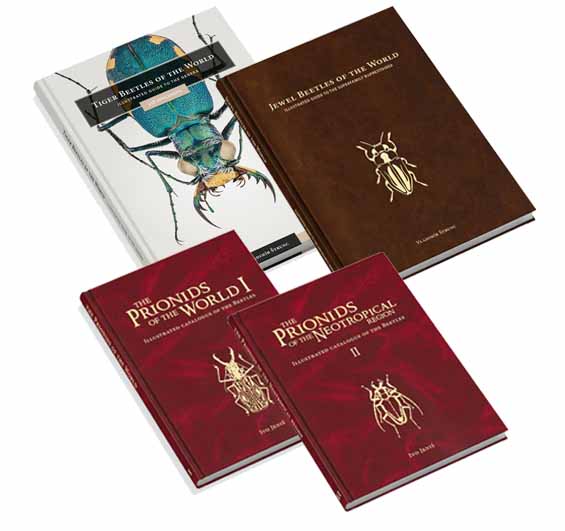
Vladimír Štrunc is an entomological book publisher based in the Czech Republic. He is the compiler of the underlying database of 295 Western Palaearctic Cerambycidae genera and the author of multiple titles on longhorn beetles, prionids, tiger beetles, ground beetles, and jewel beetles in his Insect Books publishing programme, drawing on primary taxonomic literature from Linnaeus (1758) to the present.
| Cerambycidae of the Western Paleartic I. Illustrated photographic guide · hardcover View on insect-books.com → |
Subfamily Prioninae of the World I. World monograph of the giant sawyer beetles View on insect-books.com → |
Genera and Subgenera of Tiger Beetles Sister Living Book volume on world Cicindelidae View Living Book → |
The illustrated guide Cerambycidae of the Western Paleartic I. introduced the photographic treatment of European longhorns within the Insect Books series. This Living Book takes the same fauna to the next level — a systematic, data-matrix-driven, continuously updated reference at genus and subgenus rank.
Genera and Subgenera of Longhorn Beetles is part of Štrunc’s Living Books publishing series — continuously updated scientific references, sister volume to Genera and Subgenera of Tiger Beetles.
Frequently asked questions
When will I receive the monograph?
Within 10 weeks of your pre-order. You will receive an email notification as soon as your PDF and FlipHTML5 files are ready for download.
What format does the monograph come in?
A single integrated product: a print-quality PDF extended by the FlipHTML5 interactive layer, which adds clickable navigation, zoomable plates, and full-text search on top of the same content. All DOI, BHL, GBIF, iNaturalist, and EPPO links are embedded and clickable. There is no separate PDF-only version — the FlipHTML5 interactivity is included with every pre-order.
How does the Living Book work? Do I get updates?
Yes. As part of the Living Books series, every pre-order includes 12 months of free updates from your pre-order date. The underlying data matrix is actively maintained — new species, reclassifications, expanded distribution data, EPPO status changes, and refined identification keys are pushed automatically to your FlipHTML5 access; a regenerated PDF is sent by email at each minor release (typically twice per year). After the first 12 months, continue to receive updates at exclusive subscriber pricing — and preferential rates on every future Living Books title.
How does this differ from Cerambycidae of the Western Paleartic I.?
Cerambycidae of the Western Paleartic I. is an illustrated photographic guide aimed at species-level field recognition through habitus photographs. Genera and Subgenera of Longhorn Beetles is a systematic monograph that covers all 295 Western Palaearctic genera and subgenera at data-matrix depth — 217 morphological and ecological characters, documented autapomorphies, primary references with DOI/BHL links, and a seven-key identification framework. The two works are complementary: the illustrated guide for field photographs, the Living Book for systematic and ecological depth.
Is the taxonomy up to date?
Yes. The taxonomic framework follows Danilevsky (2020), Catalogue of Palaearctic Coleoptera vol. 6(1), with the online update of 1 February 2026 fully incorporated. Family-group nomenclature follows Bouchard et al. (2024). EPPO listings are synchronised against the current EPPO Global Database.
Can I cite this monograph?
Yes. The work will receive a DOI on publication and is designed as a fully citable scientific reference, with all primary literature traceable through DOI/BHL/URL coverage.
Do you offer institutional licences and discounts?
Yes — universities, museums, forest health institutes, and libraries qualify for institutional discounts. Please contact us directly for licensing options, multi-seat access, and VAT invoicing.
Will there be a print edition?
A print edition is planned for a later date. Pre-order customers will be notified first and offered a preferential price.
Can I pay by bank transfer?
Yes. Contact us via the form below and we will send you an invoice with bank transfer details. VAT invoices are available on request.
Reserve your copy at pre-order price
The first comprehensive Western Palaearctic monograph of longhorn beetle genera and subgenera at data-matrix depth — all 295 genera and subgenera, 11 subfamilies, ~2,550 species, with a full 217-character data matrix and 307 primary references for every claim.
€79
€109
Save €30 — Launch price
✓ PDF with FlipHTML5 interactive edition
✓ 12 months of free updates
✓ Exclusive subscriber pricing thereafter
✓ Delivery within 10 weeks
✓ Stripe secure payment · VAT invoice available
✓ Notification first when print edition is released
Part of the Living Books series by Vladimír Štrunc · insect-books.com
Cerambycidae matrix v10.3 · taxonomy after Danilevsky (2020, online update 2026), Sama (2002), Bouchard et al. (2024) · audited through 1,232 logged validation entries · revised May 2026 · © 2026 Vladimír Štrunc · part of the Living Books series at insect-books.com