Dromochorus Guérin-Méneville, 1845: The Sand-Haunting Tiger Beetles of North America
Among the tiger beetles of the family Cicindelidae, few genera are as ecologically specialized and taxonomically coherent as Dromochorus Guérin-Méneville, 1845. Restricted almost entirely to the sandy prairies, river sandbars, and coastal dune systems of south-central North America, these small, cryptically patterned predators represent a remarkable example of habitat fidelity and morphological conservatism within a family otherwise celebrated for its dazzling color diversity. For the entomologist and the curious naturalist alike, Dromochorus offers a compelling window into how evolutionary pressures imposed by loose, unstable substrates can shape an entire lineage.
Systematics
The genus Dromochorus was established by Guérin-Méneville in 1845, with Dromochorus pilatei Guérin-Méneville, 1845 designated as the type species. Within the family Cicindelidae, Dromochorus is placed in the tribe Cicindelini and represents a morphologically distinct lineage united by a suite of characters including a notably convex and often velvety or pruinose dorsal surface, reduced maculation, and structural features of the mouthparts and tarsi that reflect its cursorial, sand-adapted lifestyle. The genus is treated as valid and independent, and its species are not correctly assignable to Cicindela Linnaeus, 1758 or any other genus.
Family: Cicindelidae Latreille, 1802
The genus currently comprises a modest but well-defined set of species. Among the recognized taxa are Dromochorus pilatei Guérin-Méneville, 1845; Dromochorus belfragei Schaupp, 1884; Dromochorus pruininus (Say, 1823); Dromochorus minimus Cartwright, 1936; Dromochorus rectilatera (Chaudoir, 1861); and Dromochorus nigrior Casey, 1916, among others. The taxonomy of the group was substantially clarified through the monographic work of Cartwright in the 1930s and subsequently refined by Freitag (1999) and Pearson et al. (2006), who brought modern distributional data to bear on species boundaries that had long been obscured by individual variation and substrate-driven color polymorphism.
Morphologically, Dromochorus beetles are distinguished from their closest relatives by their characteristically dull or matte dorsal coloration — often described as pruinose or velvety dark brown to black — and by the general reduction or complete absence of the bold elytral maculation typical of many other Cicindelidae. This reduction in patterning is thought to represent cryptic adaptation to dark, organically stained sandy substrates rather than a phylogenetically primitive condition. Molecular phylogenetic studies incorporating Cicindelidae have consistently supported the monophyly of the genus, reinforcing the validity of Dromochorus as a natural taxonomic unit.
Bionomics – Mode of Life
Dromochorus tiger beetles are active, visually oriented diurnal predators in their adult stage, though several species exhibit a pronounced tendency toward crepuscular activity — a behavioral shift that sets them apart from the majority of their day-flying cicindelid relatives. Adults are swift runners, relying on their long, slender legs to pursue small arthropod prey across open sand surfaces. Like all tiger beetles, they are sit-and-wait ambush predators capable of explosive sprints, but they also engage in active searching behavior, pausing periodically and raising the forebody in a characteristic posture that enhances visual scanning of the surrounding terrain.
Prey capture follows the pattern universal to Cicindelidae: the beetle detects movement, closes rapidly with a short burst of speed, and seizes the prey item with its large, falcate mandibles. The prey spectrum includes small ants, collembolans, fly larvae, and various soft-bodied invertebrates encountered on or just below the sand surface. Observations by Willis (1967) and Freitag (1999) documented that adults of several Dromochorus species will readily exploit temporarily exposed invertebrates displaced by rain events or animal disturbance, suggesting opportunistic rather than strictly stenophagous foraging strategies.
The larval biology of Dromochorus conforms to the general cicindelid plan but shows specific adaptations to friable sandy substrates. Larvae excavate vertical burrows in loose sand, lining the walls with compacted grains to maintain tunnel integrity — an engineering feat that becomes particularly demanding in the fine, dry sands preferred by most species. The larva positions itself at the burrow entrance, flush with the surface, using its heavily sclerotized head as a trap-door plug. Passing invertebrates that trigger the larva’s mechanosensory setae are seized with a rapid lunging strike. Larval development spans two to three instars and typically requires one to two full years in temperate populations, with overwintering occurring in the sealed burrow at depth.
Sexual dimorphism in Dromochorus is relatively subtle compared to some other Cicindelidae. Males tend to be marginally smaller and possess more elongate tarsal segments on the prothoracic legs, which bear adhesive setae used to grip the female elytra during mating. Copulation has been observed to occur on open sand surfaces and can be prolonged, with males maintaining the mounting posture for extended periods — a form of mate-guarding behavior that reduces the probability of sperm competition from subsequent males.
Distribution
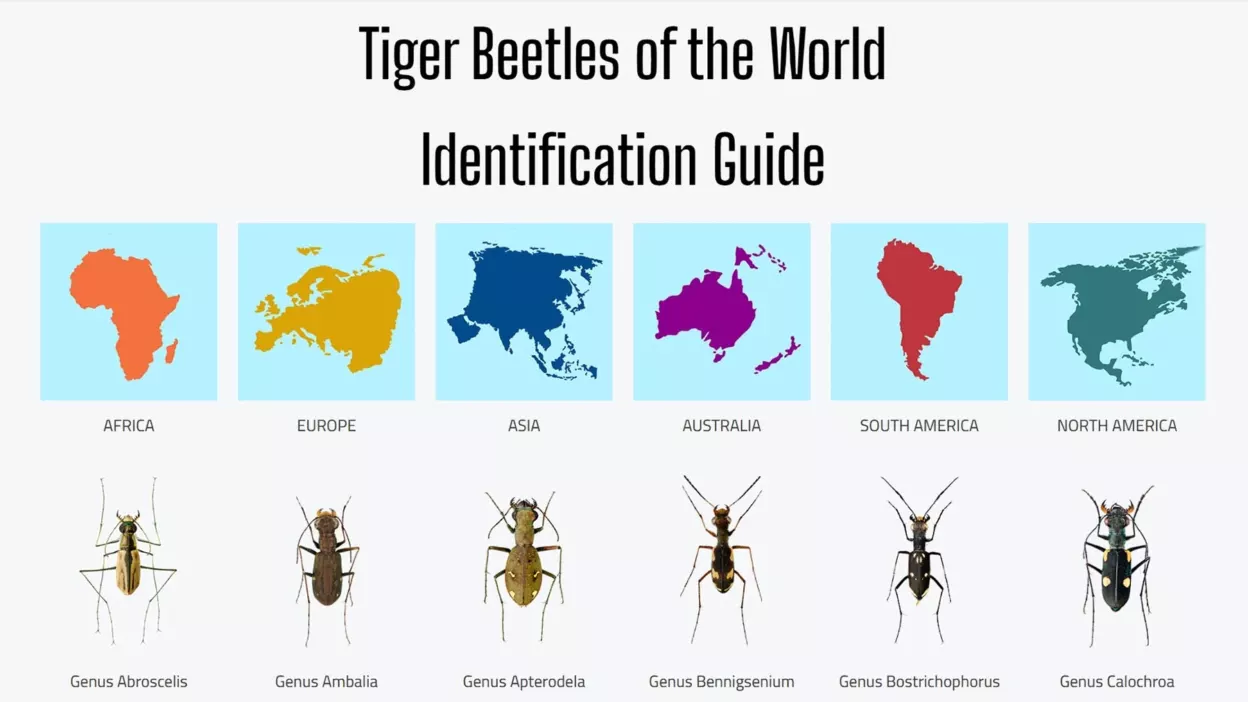
The genus Dromochorus is endemic to North America, with its center of diversity and abundance concentrated in the south-central United States, particularly in Texas, Oklahoma, Kansas, Louisiana, and adjacent states, extending southward into northeastern Mexico. This distribution broadly coincides with the zone of sandy soils associated with ancient aeolian deposits and Pleistocene-era river terraces across the interior of the continent. No species of Dromochorus occurs in Europe, Asia, or Africa, making it a strictly Nearctic genus in the biogeographic sense.
Within this broad range, individual species show markedly restricted distributions that track specific edaphic conditions rather than climate zones alone. Dromochorus pruininus (Say, 1823) has the widest documented range, occurring across much of the sandy interior south-central region, while species such as Dromochorus minimus Cartwright, 1936 are known from far more limited areas tied to specific dune fields or relict sand deposits. This pattern of distributional restriction within an already geographically confined genus makes several taxa of conservation concern, as their effective ranges may amount to only a handful of localities.
The historical range of some Dromochorus species has contracted measurably over the twentieth century in association with agricultural conversion of sandy prairies and the stabilization of formerly active dune systems through introduced grasses and woody encroachment. Freitag (1999) noted that certain populations documented from nineteenth-century collecting events had not been relocated in subsequent surveys, raising questions about local extirpation that have not been fully resolved by modern field work.
Preferred Habitats
Sand is the defining habitat element for Dromochorus, and the genus can reasonably be described as one of the most substrate-specialist groups within North American Cicindelidae. Species occur on open, sparsely vegetated sandy substrates ranging from active interior dune fields and sandy river floodplains to coastal backdune systems and the sandy margins of playa lakes. The common denominator across all recorded habitats is the combination of loose, dry to moderately moist sand with minimal vegetative cover — conditions that facilitate both the burrow construction required by larvae and the unobstructed sprinting that characterizes adult foraging.
Soil texture and color appear to be particularly critical habitat parameters. Several species show a strong preference for pale, fine-grained quartz sands, while others tolerate darker, coarser substrates. This substrate specificity is likely driven in part by thermoregulatory requirements — sandy surfaces in open sun can reach lethal temperatures, and beetles must balance thermal gain against the risk of overheating by choosing microhabitats with appropriate albedo and moisture content. Adults of thermally stressed individuals have been observed to move to shaded sand edges or to temporarily retreat into burrows during peak midday heat, a behavioral thermoregulation strategy documented across several cicindelid genera.
Vegetation structure around occupied patches is also ecologically significant. While Dromochorus beetles require open sandy ground, they frequently occur at the ecotone between bare sand and sparse herbaceous cover, where invertebrate prey density is higher than on completely denuded surfaces. Blowout features within larger dune systems — localized areas of wind-deflated, bare sand surrounded by stabilized vegetation — appear to function as particularly important microhabitat patches for some species, concentrating populations in otherwise marginal landscapes.
Moisture gradients within sandy habitats influence both larval burrowing success and adult activity timing. River sandbars subject to periodic flooding provide a mosaic of moist and dry microsites, and adults of riparian-associated species such as Dromochorus belfragei Schaupp, 1884 characteristically occupy the upper, dry portions of bars while avoiding frequently inundated surfaces. Following recession of flood waters, colonization of freshly deposited sand by adults has been observed within days, suggesting active habitat prospecting behavior.
Scientific Literature Citing the Genus and the Species
- Guérin-Méneville, F. E. (1845). Iconographie du règne animal de G. Cuvier, Insectes. Paris. [Original description of Dromochorus and Dromochorus pilatei.]
- Say, T. (1823). Descriptions of coleopterous insects collected in the late expedition to the Rocky Mountains. Journal of the Academy of Natural Sciences of Philadelphia, 3: 139–216. [Original description of taxa later transferred to Dromochorus.]
- Schaupp, F. G. (1884). Synopsis of Cicindelidae of the United States. Bulletin of the Brooklyn Entomological Society, 6: 65–88. [Description of Dromochorus belfragei.]
- Horn, G. H. (1897). The Coleoptera of Baja California. Proceedings of the California Academy of Sciences, 2(1): 302–449. [Taxonomic notes on southwestern Cicindelidae including Dromochorus.]
- Casey, T. L. (1916). Memoirs on the Coleoptera VII. New Era Printing, Lancaster, Pennsylvania. [Description of Dromochorus nigrior and related taxa.]
- Cartwright, O. L. (1936). A revision of the genus Dromochorus. Annals of the Entomological Society of America, 29(3): 433–463. [Monographic revision establishing the modern species-level framework for the genus.]
- Willis, H. L. (1967). Bionomics and zoogeography of tiger beetles of saline habitats in the central United States. University of Kansas Science Bulletin, 47(5): 145–313. [Ecological data on habitat use and prey behavior in Dromochorus and related genera.]
- Freitag, R. (1999). Catalogue of the tiger beetles of Canada and the United States. NRC Research Press, Ottawa. [Comprehensive distributional catalogue; key reference for species ranges and synonymy within Dromochorus.]
- Pearson, D. L., Knisley, C. B., and Kazilek, C. J. (2006). A field guide to the tiger beetles of the United States and Canada. Oxford University Press, New York. [Illustrated field guide with habitat notes, distribution maps, and ecological accounts for all Dromochorus species.
- Pearson, D. L., and Vogler, A. P. (2001). Tiger beetles: the evolution, ecology, and diversity of the cicindelids. Cornell University Press, Ithaca. [Broad synthetic treatment of Cicindelidae biology, with discussion of substrate specialization relevant to Dromochorus.]
- Knisley, C. B., and Schultz, T. D. (1997). The biology of tiger beetles and a guide to the species of the South Atlantic states. Virginia Museum of Natural History Special Publication, 5: 1–210. [Larval biology and habitat ecology with comparative data applicable to Dromochorus.]
Frequently Asked Questions (FAQ)
What exactly is Dromochorus, and is it really a separate genus from Cicindela?
Dromochorus Guérin-Méneville, 1845 is a valid, independent genus within the family Cicindelidae, the tiger beetles. While the genus was historically caught up in the broad, catch-all concept of Cicindela used by earlier authors, modern taxonomic revisions — beginning with Cartwright’s monograph in 1936 and refined through subsequent molecular and morphological work — firmly establish Dromochorus as a natural group distinct from Cicindela Linnaeus, 1758. Its species are correctly cited under Dromochorus, not under any other genus.
How many species does Dromochorus contain?
The genus currently encompasses around six to eight recognized species, depending on the taxonomic authority consulted. Well-established species include Dromochorus pilatei Guérin-Méneville, 1845 (the type species), Dromochorus belfragei Schaupp, 1884, Dromochorus pruininus (Say, 1823), Dromochorus minimus Cartwright, 1936, Dromochorus rectilatera (Chaudoir, 1861), and Dromochorus nigrior Casey, 1916. The exact species count remains subject to ongoing revision as distributional surveys and genetic analysis continue to clarify the boundaries between closely related populations.
Where can I find Dromochorus tiger beetles in the wild?
Your best prospects lie in the sandy interior landscapes of Texas, Oklahoma, Kansas, and Louisiana, as well as adjacent areas of northeastern Mexico. Look for open, sparsely vegetated sandy ground: active dune fields, sandy river floodplain bars, sandy prairie blowouts, and the margins of playa lakes all represent prime habitat. Adults are most active during warm months, typically from late spring through early autumn, and some species are more reliably encountered in the early morning or late afternoon than at midday when surface temperatures peak.
Why do Dromochorus beetles look so dull compared to other tiger beetles?
The matte, velvety, often uniformly dark brown or blackish coloration of Dromochorus contrasts sharply with the metallic, boldly patterned elytra typical of many cicindelid genera, and this difference is almost certainly adaptive. Their dark substrates — organically stained, moist sand; shadowed dune hollows — favor cryptic coloration over conspicuousness. Reduced or absent elytral maculation provides camouflage against visually hunting predators such as birds, while the pruinose texture of the dorsal surface may also serve thermoregulatory functions by modifying how the beetle absorbs and reflects radiation on sun-exposed sand surfaces.
How do Dromochorus larvae build and maintain their burrows in loose sand?
Larval Dromochorus excavate vertical tunnels by loosening sand grains with their mandibles and pushing debris upward and out of the entrance using their flattened head and pronotum as a shovel. The burrow walls are stabilized by compaction and, in some cases, by secretions that bind grains together, preventing collapse in the particularly fine, dry sands these beetles inhabit. The larva maintains its position at the entrance with the flattened head serving as a living trapdoor, supported by a distinctive dorsal hook on the fifth abdominal segment that braces against the burrow walls and allows the larva to resist being pulled out by struggling prey.
Are any Dromochorus species considered threatened or endangered?
Several species with highly restricted ranges and dependence on specific sandy habitat patches are of genuine conservation concern, even if none currently holds formal federal listing status in the United States. The conversion of sandy prairies to agriculture, the stabilization of active dune systems through invasive grass establishment, and increased recreational pressure on river sandbars all erode the open, sandy microhabitats upon which Dromochorus depends. Species such as Dromochorus minimus Cartwright, 1936, with its very limited known range, warrant particular monitoring attention.
Do Dromochorus tiger beetles fly?
Unlike many of their cicindelid relatives, which are notably strong and frequent fliers, adult Dromochorus beetles are generally reluctant to take flight and rely predominantly on running to escape threats and pursue prey. While the hindwings are present and functional in most species — making them fully capable of flight in principle — sustained or spontaneous flight is rarely observed in the field. This tendency toward a cursorial rather than volant lifestyle is consistent with life on open sand, where running is an energetically efficient means of covering ground and where flight might increase exposure to avian predators.
What eats Dromochorus tiger beetles?
The predator community bearing on Dromochorus adults includes insectivorous birds, robber flies (Asilidae), and various spider species that inhabit sandy ground. The matte coloration of adults provides some camouflage, but when disturbed they rely primarily on rapid evasive running and, if pressed, short escape flights. Larvae within their burrows face predation from parasitoid wasps of the genus Methocha (Thynnidae), which are specialized hunters of cicindelid larvae — the wasp enters the burrow, stings the larva into paralysis, and deposits an egg on the immobilized host.
How can I distinguish Dromochorus from similar-looking tiger beetle genera?
In the field, Dromochorus can be separated from most other North American Cicindelidae by the combination of their small to medium body size, uniformly dull dark dorsal coloration with reduced or absent pale elytral spots, convex and often velvety elytral surface, and their characteristic sandy habitat. Species of Cicindelidia and some Cicindela that share sandy habitats tend to be more metallic or show bolder maculation. In hand, genitalic characters and details of elytral microsculpture are used to confirm species-level identifications; Pearson et al. (2006) provide the most accessible illustrated key for field workers.
Is there ongoing scientific research on Dromochorus?
Active research on Dromochorus is relatively sparse compared to more speciose or charismatic cicindelid genera, but the group continues to attract attention from systematists interested in substrate-driven speciation in North American tiger beetles and from conservation biologists monitoring sandy habitat loss across the south-central United States. Molecular phylogenetic studies of Cicindelidae published in recent years have included Dromochorus taxa and have generally corroborated the morphology-based genus boundaries established by earlier workers, while also raising questions about the precise relationships among species that future targeted sampling may resolve.