Tragosoma depsarium (Linnaeus, 1767)
Classification
The taxonomic classification of Tragosoma depsarium is as follows:
Kingdom: Animalia
Phylum: Arthropoda
Class: Insecta
Order: Coleoptera
Suborder: Polyphaga
Infraorder: Cucujiformia
Superfamily: Chrysomeloidea
Family: Cerambycidae
Subfamily: Prioninae
Tribe: Tragosomini
Genus: Tragosoma Dejean, 1821
Species: Tragosoma depsarium (Linnaeus, 1767)
Synonymy
Cerambyx depsarius Linnaeus, 1767 (original combination)
Prionus depsarius (Linnaeus, 1767)
Tragosoma depsarium depsarium (Linnaeus, 1767) (nominal subspecies)
The genus Tragosoma is small, containing only a few species distributed across the Holarctic region. T. depsarium is the type species and is predominantly European and Asian in distribution. Some authorities recognize subspecies or closely related taxa in eastern Asia and North America, though taxonomic relationships within the genus remain subject to ongoing revision. Wikipedia
Distribution an
-
Subfamily Prioninae of the World
$125.00 Add to cart -
The Prionids Collection Bundle
Sale! Original price was: $149.00.$91.00Current price is: $91.00. Add to cart -

The Prionids of the World
Sale! Original price was: $75.00.$68.00Current price is: $68.00. Add to cart -
The Prionids of the Neotropical region
Sale! Original price was: $75.00.$68.00Current price is: $68.00. Add to cart
Common Names
Tragosoma depsarium is commonly known as the “Hairy pine borer” or “Spruce longhorn” in English. In German, it is called “Behaarter Mulmbock” or “Zottenbock,” in French “prione velu,” and in Czech “tesařík chundelatý.” These vernacular names reference the species’ distinctive dense vestiture of long, erect setae (hairs) covering the body.
Morphology
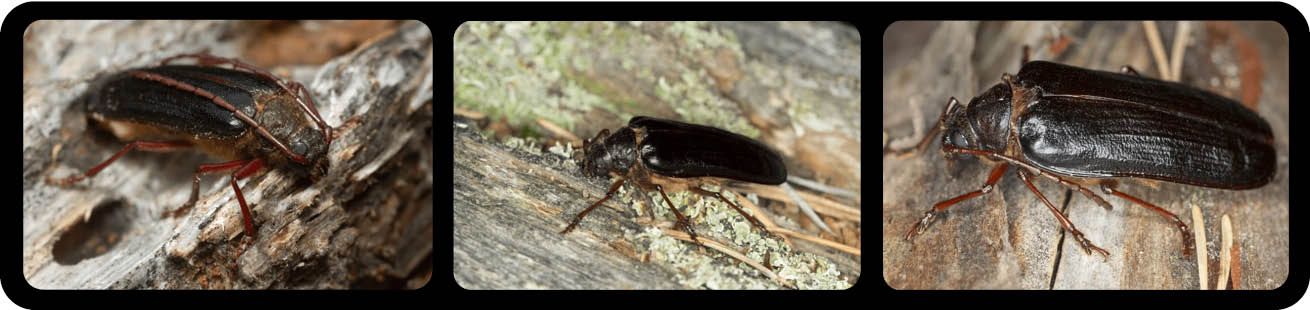
Tragosoma depsarium is a medium to large-sized prionine beetle with highly distinctive morphological features that readily distinguish it from other European Cerambycidae.
Subfamily Prioninae of the World I.
The Prionids of the World
The Prionids of the Neotropical Region
The Prionids Collection Bundle
Adult Morphology
Adults exhibit considerable size variation, measuring 18-40 mm in body length, with females typically larger than males. The species displays moderate sexual dimorphism, primarily in antennal development and body proportions.
The most characteristic feature is the dense vestiture of long, erect, golden-yellow to brownish setae covering the entire body, giving the beetle a remarkably hairy or shaggy appearance unique among European longhorn beetles. This pilosity is particularly dense on the pronotum, elytra, and ventral surface.
Coloration and Integument:
The basic body coloration is dark brown to black, though this is largely obscured by the dense pubescence. The elytra appear mottled or variegated due to irregular patches of shorter, appressed pale yellowish setae interspersed among the longer erect setae. Fresh specimens often show a more uniform golden-brown appearance, while older individuals may appear darker as setae are worn or lost.
Head:
The head is relatively broad, strongly constructed, and deeply inserted into the prothorax. Compound eyes are large, reniform, and moderately emarginate. The frons and vertex are densely pubescent. Mandibles are robust, curved, and well-developed in both sexes, though males possess slightly larger mandibles. The labrum is transverse and setose.
Antennae:
Antennae consist of 11 segments and are moderately robust with pronounced serration. In males, antennae extend to approximately two-thirds of body length, with segments 3-10 produced into distinct triangular projections giving a strongly serrate appearance. Antennal segments are densely setose. Female antennae are shorter, extending to about half the body length, with less pronounced serrations. The scape (first segment) is relatively short and stout.
Pronotum:
The pronotum is transverse (broader than long), strongly convex, and possesses three lateral teeth on each side, with the anterior and posterior teeth acute and the middle tooth variable in prominence. The pronotal surface is coarsely and irregularly punctate beneath the dense pubescence. A median longitudinal groove or impression is often present but may be obscured by setae.
Scutellum:
The scutellum is relatively small, triangular, and densely pubescent.
Elytra:
Elytra are elongate, parallel-sided, covering the entire abdomen, and slightly flattened dorsally. The elytral surface is coarsely punctate-rugose with irregular, weak longitudinal costae (ridges) that are often difficult to discern beneath the pubescence. Elytra taper very slightly toward the apex, which is individually rounded. The dense vestiture creates a characteristic mottled appearance with irregular patches of contrasting lighter and darker pubescence.
Legs:
Legs are robust and relatively short. Femora are clavate (club-shaped), particularly the hind femora, and densely covered with long setae. Tibiae bear two apical spurs and are also densely setose. The tarsal formula is 5-5-5, with tarsomeres bearing dense pubescence ventrally. The fourth tarsomere is deeply bilobed. Tarsal claws are simple, without teeth or serrations.
Ventral Surface:
The ventral surface including prosternum, mesosternum, metasternum, and abdominal sternites is densely covered with long, erect yellowish setae, giving a distinctly shaggy appearance.
Sexual Dimorphism
Sexual dimorphism is moderate and includes:
- Size: Females are generally larger and more robust than males
- Antennae: Male antennae are longer and more strongly serrate
- Body proportions: Females have a broader, more robust abdomen
- Mandibles: Males possess slightly larger, more curved mandibles
Larval Morphology
Larvae are typical prionine wood-borers, reaching 35-50 mm in length when fully developed. The body is elongate, cylindrical, fleshy, and creamy-white to pale yellowish. The head capsule is heavily sclerotized, robust, and dark reddish-brown to black with powerful mandibles adapted for boring through wood.
Thoracic segments are swollen, particularly the prothorax, which is dorsoventrally flattened and broader than the head. Thoracic legs are present but small and reduced, three-segmented with terminal claws. Abdominal segments are relatively uniform in diameter and bear dorsal and ventral ampullae (ambulatory tubercles) bearing minute setae that assist in locomotion within galleries.
The body surface is sparsely setose with fine, short setae. Spiracles are well-developed on the thoracic and abdominal segments, adapted for respiration in confined galleries.
Biology and Life Cycle
Tragosoma depsarium exhibits a life cycle typical of prionine beetles, characterized by prolonged larval development in dead or dying coniferous wood.
Developmental Period
The complete life cycle typically requires 3-5 years from egg to adult emergence, though development time varies considerably depending on environmental conditions, wood quality, temperature, and substrate characteristics. In optimal conditions with warm temperatures and suitable wood, development may be completed in 2-3 years, while under suboptimal conditions it may extend to 6 years or more.
Adult Biology and Phenology
Adults are crepuscular and nocturnal, with activity concentrated during warm summer evenings and nights. The flight period extends from June through August in most of the European range, with peak emergence typically occurring in July. In mountainous or northern regions, emergence may be delayed until late July or early August.
Flight and Dispersal:
Both sexes are capable of flight, though flight activity is most pronounced in males, which actively search for females. Flight occurs primarily during warm evenings and nights, typically when temperatures exceed 15°C. Males are strongly attracted to artificial light sources, particularly mercury vapor and UV lights, and are frequently encountered at light traps. Females are less frequently observed at lights, remaining closer to host material.
Adult Behavior:
Adults do not feed or feed only minimally on moisture, sap flows, or honeydew. The adult stage is primarily dedicated to reproduction, with adults relying on energy reserves accumulated during larval development. Adult longevity is relatively short, typically 2-4 weeks under natural conditions.
Males locate females through pheromone detection, with females releasing volatile sex pheromones that attract males over considerable distances. The chemical composition of these pheromones has been studied and includes specific terpenoid compounds.
Mating:
Mating occurs on or near host material, including stumps, fallen logs, or standing dead trees. Copulation may last several hours. Males may mate multiple times if they encounter additional females.
Oviposition and Egg Development
Females possess a short, robust ovipositor capable of inserting eggs into bark crevices, under loose bark scales, or in existing cracks and fissures in wood. Oviposition sites are selected based on wood characteristics including moisture content, decay stage, bark condition, and microclimatic factors.
Eggs are deposited individually or occasionally in small groups of 2-3. A single female may produce 50-150 eggs during her lifetime, though fecundity varies with female size and condition. Eggs are oval, creamy-white, and measure approximately 3-4 mm in length.
Egg development (incubation period) lasts 2-3 weeks depending on temperature, with optimal development occurring at temperatures of 20-25°C.
Larval Development and Feeding Ecology
Newly hatched larvae are small, approximately 5-6 mm in length, and initially feed in the phloem and inner bark layers. As they develop, larvae bore into the sapwood, creating irregularly winding galleries that increase in diameter with larval growth.
Gallery Characteristics:
Larval galleries are oval to flattened in cross-section, measuring 8-15 mm in width when created by mature larvae. Galleries wind irregularly through the wood, primarily in sapwood but occasionally extending into heartwood, particularly in well-decayed material. Galleries are loosely packed with coarse, fibrous frass consisting of wood particles and larval excrement.
Feeding Behavior:
Larvae feed continuously during warmer months (spring through autumn) but become inactive or enter dormancy during winter months when temperatures drop. Feeding activity resumes in spring as temperatures rise. The species appears to utilize both wood tissue and associated fungi for nutrition, with larval galleries frequently colonized by wood-decay fungi.
Development Stages:
Larvae progress through multiple instars, probably 8-10 stages, though precise instar numbers are difficult to determine due to variable development rates. Growth is most rapid during the second and third years of development.
Pupation and Adult Emergence
When fully developed, mature larvae construct pupal chambers within the wood, typically 3-10 cm from the surface. The pupal chamber is oriented parallel to the wood grain, oval in shape, and may be superficially lined with fine wood particles. Chamber construction typically occurs in late spring (April-May).
Pupation occurs from late spring through early summer (May-June), with the pupal stage lasting approximately 3-4 weeks. Pupae are exarate (free-limbed), initially pale yellowish-white, progressively darkening as adult pigmentation develops.
Newly emerged adults (teneral adults) remain in the pupal chamber for several days to 1-2 weeks, allowing the integument to harden and darken and setae to fully develop. Adults then excavate exit tunnels to the wood surface, emerging through oval exit holes measuring 6-10 mm in diameter.
Ecology
Host Plants and Substrate Requirements
Tragosoma depsarium is a specialist on coniferous trees, exhibiting strong fidelity to Pinaceae with occasional records from other conifer families.
Primary Host Plants:
- Spruces (Picea spp.) – particularly P. abies (Norway spruce), considered the preferred host throughout much of the range
- Pines (Pinus spp.) – including P. sylvestris (Scots pine), P. mugo (mountain pine), P. cembra (Swiss stone pine)
- Firs (Abies spp.) – including A. alba (silver fir), A. nordmanniana (Nordmann fir)
- Larches (Larix spp.) – L. decidua (European larch), L. kaempferi (Japanese larch)
Occasional or Secondary Hosts:
- Douglas-fir (Pseudotsuga menziesii)
- Various ornamental conifers in parks and gardens
Substrate Characteristics:
The species colonizes dead and dying coniferous wood in various forms:
- Standing dead trees (snags) with intact or partially missing bark
- Large fallen logs and trunks
- Stumps from felling operations
- Large branches of recently dead trees
- Occasionally, severely weakened living trees
Tragosoma depsarium shows preference for wood in early to intermediate stages of decay, typically colonizing material 1-5 years after tree death. The species generally requires wood with bark still largely intact or recently shed, adequate moisture content (but not waterlogged), and partial fungal colonization. Wood diameter is important, with the species preferentially colonizing material >20 cm in diameter.
Habitat Requirements and Distribution Patterns
Tragosoma depsarium is characteristic of boreal, montane, and submontane coniferous forests throughout its range.
Habitat Types:
- Primary Habitats:
- Boreal coniferous forests (taiga)
- Montane and subalpine spruce and pine forests
- Mixed coniferous-deciduous forests with significant conifer component
- Old-growth and mature coniferous forests
- Secondary Habitats:
- Managed conifer plantations with adequate deadwood retention
- Forest clearings and recently harvested areas with retained logs
- Storm damage areas (windthrow sites)
- Parks and cemeteries with mature conifers
Habitat Features:
Critical habitat components include:
- Presence of recently dead or dying coniferous trees
- Adequate volumes of large-diameter deadwood (>20 cm)
- Forest structural complexity with canopy gaps
- Relatively undisturbed conditions allowing natural mortality
- Stumps and logging residues in managed forests
Microclimate Preferences:
The species shows some preference for:
- Partially shaded to sun-exposed deadwood
- Moderately humid conditions (not excessively dry or waterlogged)
- Wood with partial bark retention
- Sites with adequate air circulation preventing excessive moisture
Altitudinal Distribution
Tragosoma depsarium exhibits a broad altitudinal range but is predominantly a montane and boreal species:
- Lowlands: Occasional to locally common, primarily in boreal regions
- Colline zone (200-600 m): Present where suitable coniferous forests occur
- Montane zone (600-1500 m): Common to abundant, optimal elevation range
- Subalpine zone (1500-2200 m): Present to common in upper conifer forests
- Maximum elevation: Up to approximately 2200-2300 m in Alpine regions
The species reaches highest abundance in montane spruce forests between 800-1600 m elevation in Central European mountain ranges.
Associated Organisms and Ecological Interactions
Tragosoma depsarium participates in complex ecological communities associated with dead coniferous wood.
Fungal Associations:
Larval galleries are invariably colonized by wood-decay fungi, which may play important nutritional roles:
- White-rot fungi: Including Fomitopsis spp., Trichaptum spp., Phellinus spp.
- Brown-rot fungi: Gloeophyllum spp., Antrodia spp.
- Staining fungi: Various ascomycetes and ophiostomatoid fungi
The relationship between larvae and fungi appears mutualistic or commensal, with fungi pre-digesting wood lignin and cellulose, making nutrients more accessible to larvae. Larvae may also directly consume fungal mycelium as a protein source.
Competitors:
Tragosoma depsarium larvae may compete for resources with other saproxylic beetles including:
- Other Prioninae: Ergates faber in overlapping habitats
- Cerambycinae: Tetropium spp., Rhagium spp.
- Buprestidae: Various jewel beetles colonizing similar substrates
- Curculionidae: Weevils in the subfamily Scolytinae (bark beetles)
Competition may be reduced through temporal or spatial partitioning of resources and differences in wood decay preferences.
Predators and Parasitoids:
Larval Predators:
- Woodpeckers (Picidae) – particularly Dendrocopos spp., Picoides spp., which excavate wood to access larvae
- Other beetle larvae – predatory Cleridae, Trogossitidae
- Ants – particularly Formica spp. that may access galleries
Larval Parasitoids:
- Hymenoptera: Ichneumonidae (ichneumon wasps), Braconidae
- Diptera: Tachinidae (parasitic flies)
Adult Predators:
- Bats – capturing flying adults at night
- Nocturnal birds – nightjars, owls
- Spiders – capturing adults on wood surfaces
Commensals and Secondary Colonizers:
Galleries and emergence holes created by Tragosoma depsarium provide microhabitats for numerous secondary organisms:
- Mites (Acari) – various free-living and predatory species
- Springtails (Collembola)
- Pseudoscorpions (Pseudoscorpiones)
- Secondary wood-boring beetles utilizing existing galleries
- Nesting sites for solitary bees and wasps
Ecological Role and Ecosystem Functions
Tragosoma depsarium performs important ecological functions in coniferous forest ecosystems:
Nutrient Cycling and Decomposition:
The species contributes significantly to breakdown of coniferous deadwood, particularly in montane and boreal ecosystems where it may be abundant. Larval feeding:
- Accelerates wood fragmentation and surface area expansion
- Facilitates fungal and microbial colonization
- Increases water penetration and retention
- Speeds nutrient release into soil and forest floor
- Contributes to carbon cycling
Structural Modification:
Larval galleries create three-dimensional structural complexity within deadwood:
- Increase porosity and internal surface area
- Create microhabitat heterogeneity
- Provide refugia for numerous other organisms
- Affect wood durability and decomposition rates
Food Web Support:
The species serves as prey for specialized predators including woodpeckers, contributing to forest food web dynamics. Presence of Tragosoma depsarium populations may support woodpecker populations, which in turn provide ecosystem services through cavity creation.
Indicator Value:
Tragosoma depsarium serves as an indicator of:
- Coniferous forest habitat quality
- Deadwood availability and diversity
- Forest naturalness and continuity
- Relatively undisturbed forest conditions
- Presence of veteran trees and natural mortality processes
Distribution
Tragosoma depsarium has a predominantly Palearctic distribution with a strong association with boreal and montane coniferous forests.
Geographic Range
European Distribution:
The species occurs across a broad latitudinal range in Europe:
- Northern Europe: Throughout Fennoscandia including Norway, Sweden, and Finland; widespread in boreal forests
- British Isles: Scotland (Highlands), very rare or absent from England, Wales, and Ireland
- Central Europe: Present in all major mountain ranges:
- Alps (Austria, Switzerland, southern Germany, Italy, France, Slovenia)
- Carpathians (Poland, Slovakia, Romania, Ukraine)
- Sudetes (Czech Republic, Poland)
- Black Forest and other German uplands
- Bohemian Forest/Šumava
- Vosges, Jura
- Eastern Europe: Widespread in Baltic countries, Russia, Belarus, Ukraine in appropriate forest types
- Southern Europe:
- Pyrenees (Spain, France)
- Apennines (Italy)
- Balkan mountains (Bulgaria, North Macedonia, Greece)
- Rare or absent from Mediterranean lowlands
Asian Distribution:
The species extends eastward through:
- Russia: Throughout Siberia to the Far East, Kamchatka
- Kazakhstan, Mongolia
- China: Northern and northeastern regions
- Korea
- Japan: Hokkaido and northern Honshu
North American Status:
Taxonomic uncertainty exists regarding North American populations. Some authorities recognize Tragosoma depsarium harrisii (LeConte) from eastern North America or treat it as a distinct species T. harrisii. Further taxonomic research is needed to clarify relationships between Palearctic and Nearctic populations.
Distribution Patterns and Biogeography
Latitudinal Pattern:
The species shows highest abundance in boreal and montane zones, with distribution primarily between 45°N and 70°N in Europe. Southern distribution is restricted to mountainous areas with suitable coniferous forests.
Altitudinal Pattern:
In southern and central Europe, the species is primarily montane, occurring predominantly above 600-800 m. In northern Europe (Scandinavia, Baltic region, Russia), it occurs from sea level to upper forest limits.
Habitat Connectivity:
Distribution is closely tied to coniferous forest distribution, particularly spruce forests. The species may show disjunct or patchy distributions in regions where suitable habitat is fragmented, particularly in Central European lowlands and southern mountain ranges.
Postglacial Colonization:
Current distribution reflects postglacial colonization patterns, with the species likely surviving in glacial refugia in southern mountains and expanding northward and to higher elevations as climate warmed and coniferous forests expanded.
Conservation Status and Threats
The conservation status of Tragosoma depsarium varies considerably across its range, reflecting differences in forest management intensity, habitat availability, and regional populations.
Conservation Status Assessments
International and Continental:
- IUCN Red List: Not evaluated at global level
- European Red List: Generally considered Least Concern due to widespread distribution, though regional assessments vary
- Habitat Directive (EU): Not listed in annexes
National and Regional Status:
Conservation status varies substantially:
- Scandinavia and Russia: Generally common to abundant; considered Least Concern
- Alpine Countries: Locally common in appropriate montane habitats; generally secure
- Central European Lowlands: Rare to very rare; listed as Vulnerable or Endangered in some regions (e.g., parts of Germany, Netherlands, Belgium)
- British Isles: Very rare; of conservation concern in Scotland
- Southern Europe: Scattered populations in mountain ranges; status varies locally
Legal Protection:
The species is legally protected in some countries and regions including parts of Germany, Switzerland, and the United Kingdom, where removal or disturbance may be prohibited.
Threats and Declining Factors
Habitat Loss and Degradation:
- Forest Management Intensification:
- Short rotation cycles preventing tree maturity and natural mortality
- Removal of deadwood from managed forests
- Salvage logging of storm-damaged, diseased, or fire-killed trees
- Stump extraction and removal of logging residues
- Conversion of natural/semi-natural forests to intensive plantations
- Forest Fragmentation:
- Isolation of suitable habitat patches
- Reduced connectivity limiting dispersal and gene flow
- Small population sizes vulnerable to stochastic events
Climate Change:
- Habitat Shifts:
- Upward and northward shifts in suitable climate zones
- Potential reduction of suitable montane habitat in southern mountains
- Changes in tree species composition and forest types
- Disturbance Regimes:
- Increased frequency and severity of storms providing temporary habitat pulses
- Bark beetle outbreaks creating extensive deadwood but often followed by intensive salvage logging
- Increased fire frequency in some regions
- Drought stress affecting host tree health
Pest Management:
- Intensive control of bark beetles and other forest insects may incidentally affect Tragosoma depsarium populations through:
- Removal of potential breeding substrate
- Insecticide applications in some contexts
- Disruption of saproxylic community structure
Conservation and Management Recommendations
Forest Management Strategies:
Deadwood Retention:
- Retain adequate volumes of large-diameter coniferous deadwood in managed forests (target: >20 m³/ha)
- Leave stumps at varied heights (0.5-2 m) after felling operations
- Retain storm-damaged trees and snags where safety permits
- Create deadwood by ring-barking or topping selected trees
Habitat Continuity:
- Maintain continuous availability of deadwood across forest landscape
- Extend rotation periods to allow natural mortality
- Retain veteran trees and groups of old trees
- Implement retention forestry practices
Silvicultural Practices:
- Reduce salvage logging intensity, particularly in protected areas
- Leave portions of wind-throw and bark beetle damage areas unmanaged
- Maintain structural diversity within forest stands
- Promote natural regeneration and mixed-age structures
Protected Areas:
- Ensure adequate representation of coniferous forests in protected area networks
- Implement specific management for saproxylic beetle conservation in key sites
- Establish forest reserves with minimal intervention
- Maintain buffer zones around core habitats
Monitoring and Research:
- Establish monitoring programs in key populations
- Study population dynamics and habitat requirements
- Investigate impacts of climate change on distribution and phenology
- Research connectivity and metapopulation dynamics
- Assess effectiveness of conservation measures
Landscape-Scale Approaches:
- Maintain habitat networks across forest landscapes
- Coordinate conservation efforts across ownership boundaries
- Integrate saproxylic conservation into broad forest planning
- Promote awareness among forest managers and owners
Economic Significance
Historical and Contemporary Perspectives
Unlike some other prionine beetles, Tragosoma depsarium has rarely been considered an economically significant pest. The species’ strong preference for dead and dying wood means it does not attack healthy timber, and its montane/boreal distribution often places it in forests managed less intensively than lowland production forests.
Forestry Impacts:
Historical Concerns:
- Occasionally mentioned in older forestry literature as potentially damaging to stored timber or wood in sawmills
- Some concern in regions where recently killed or wind-thrown timber was stored before processing
- Minor damage to wooden structures (rare, primarily historical)
Contemporary Context:
- Economically insignificant in modern forestry due to:
- Rapid processing of commercial timber
- Preference for material unsuitable for timber production
- Primary colonization of already degraded or dead wood
- May develop in stumps and logging residues but causes no economic loss
Timber Quality:
- Larvae developing in stored logs could theoretically cause devaluation through gallery formation
- In practice, rarely encountered in commercial timber due to modern forestry practices
- Any impact far outweighed by other wood-boring species if timber is not rapidly processed
Positive Economic and Ecological Values
Ecosystem Services:
Tragosoma depsarium provides valuable ecosystem services that contribute to forest sustainability:
- Nutrient Cycling: Accelerates decomposition and nutrient release, maintaining forest productivity
- Biodiversity Support: Creates microhabitats supporting diverse saproxylic communities
- Forest Health: Participates in natural forest dynamics and succession
- Carbon Cycling: Contributes to carbon turnover in forest ecosystems
Indicator and Monitoring Value:
- Serves as indicator species for forest biodiversity assessments
- Presence indicates adequate deadwood resources and habitat quality
- Useful in forest certification schemes (FSC, PEFC) as biodiversity indicator
- Contributes to ecological monitoring programs
Educational and Scientific Value:
- Prominent species useful for public education about forest ecology
- Subject of scientific research on saproxylic beetles and deadwood ecology
- Contributes to understanding of boreal and montane forest ecosystems
- Charismatic species (due to distinctive hairy appearance) for conservation outreach
Ecotourism Potential:
- Distinctive appearance makes the species appealing for nature tourism
- Contributes to overall forest biodiversity valued in ecotourism
- Can be featured in interpretive programs about forest ecology
Contemporary Management Perspective
The modern perspective recognizes Tragosoma depsarium as a valuable component of forest biodiversity rather than a pest. Conservation of the species aligns with broader goals of sustainable forest management, biodiversity conservation, and maintenance of ecosystem functions. Integration of saproxylic beetle conservation, including Tragosoma depsarium, into forest management represents best practice in contemporary forestry and contributes to forest certification standards and environmental stewardship objectives.