Aegosoma scabricorne (Scopoli, 1763)
Classification
The taxonomic classification of Aegosoma scabricorne is as follows:
Kingdom: Animalia
Phylum: Arthropoda
Class: Insecta
Order: Coleoptera
Suborder: Polyphaga
Infraorder: Cucujiformia
Superfamily: Chrysomeloidea
Family: Cerambycidae
Subfamily: Prioninae
Tribe: Aegosomatini
Genus: Aegosoma Audinet-Serville, 1832
Species: Aegosoma scabricorne (Scopoli, 1763)
Synonymy
Cerambyx scabricornis Scopoli, 1763 (original combination)
Aegosoma scabricornis (Scopoli, 1763) (alternative spelling)
The genus Aegosoma currently contains approximately 10 recognized species, primarily distributed across the Palearctic region. The tribal placement within Aegosomatini groups Aegosoma with other large-bodied prionine genera that share morphological characteristics such as robust mandibles, serrate antennae, and association with deadwood habitats. Wikipedia
Distribution an
-
Subfamily Prioninae of the World
$125.00 Add to cart -
The Prionids Collection Bundle
Sale! Original price was: $149.00.$91.00Current price is: $91.00. Add to cart -

The Prionids of the World
Sale! Original price was: $75.00.$68.00Current price is: $68.00. Add to cart -
The Prionids of the Neotropical region
Sale! Original price was: $75.00.$68.00Current price is: $68.00. Add to cart
Taxonomic Position
Aegosoma scabricorne belongs to the subfamily Prioninae within the family Cerambycidae (longhorn beetles). This subfamily is characterized by large body size, robust build, and serrate or flabellate antennae. The genus Aegosoma contains several species distributed across the Palearctic region, with A. scabricorne being one of the most widespread European representatives.
Subfamily Prioninae of the World I.
The Prionids of the World
The Prionids of the Neotropical Region
The Prionids Collection Bundle
Morphology
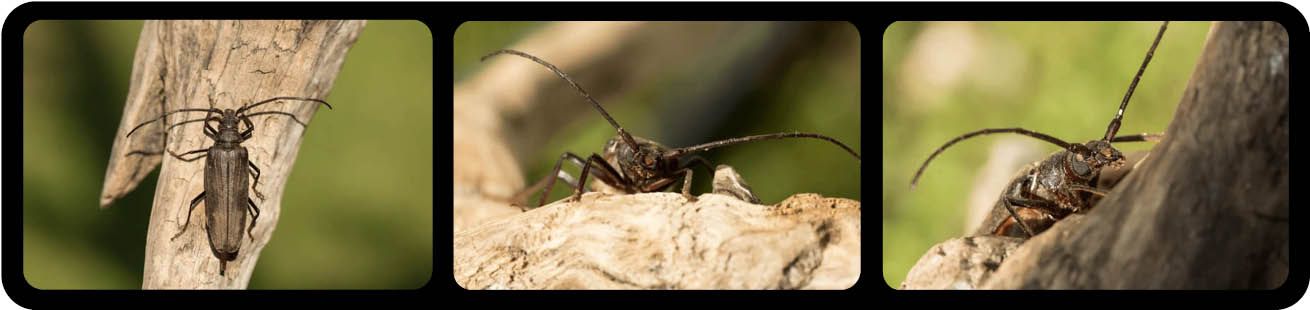
Adults of A. scabricorne are among the largest longhorn beetles in Europe, measuring 30-55 mm in body length. The species exhibits sexual dimorphism, with males typically larger than females. The body coloration ranges from dark reddish-brown to black, with a characteristic rough, granulated surface texture on the elytra and pronotum—a feature reflected in the specific epithet “scabricorne” (meaning rough-horned).
The antennae are relatively short for a cerambycid, reaching only about half the body length in females and two-thirds in males. They consist of 11 segments with the third segment being the longest. The mandibles are well-developed and prominent, particularly in males, which use them during mating competition. The tarsal formula is 5-5-5, typical for the family.
Biology and Life Cycle
Aegosoma scabricorne is a saproxylic species with a prolonged larval development period. The life cycle typically spans 3-5 years, though this can vary depending on environmental conditions and wood quality. Adults emerge during summer months (June-August), with peak activity occurring at dusk and during nighttime hours. They are attracted to light sources, which facilitates their observation and study.
Females oviposit in crevices of dead or dying deciduous trees, showing a strong preference for beech (Fagus sylvatica) and oak (Quercus spp.). Eggs are deposited individually or in small clusters beneath bark scales. Larvae are xylophagous, feeding within the sapwood and heartwood of standing dead trees, stumps, and large fallen timber with advanced decay. Their galleries are spacious and filled with coarse frass.
The larval stage is the longest phase of development. Mature larvae can reach 70-80 mm in length and are cream-colored with a characteristic prionine body form—robust, cylindrical, with reduced legs and a sclerotized head capsule. Pupation occurs within the wood in a chamber constructed by the larva, typically during late spring.
Habitat and Distribution
Aegosoma scabricorne is distributed throughout much of Europe, extending from the Iberian Peninsula to the Caucasus, and from southern Scandinavia to the Mediterranean. The species inhabits mature and old-growth deciduous forests, particularly those with substantial deadwood availability.
As a saproxylic species, A. scabricorne serves as an indicator of forest habitat quality and continuity. It requires forests with adequate volumes of large-diameter deadwood in intermediate to advanced decay stages. Such habitat requirements make the species vulnerable to intensive forest management practices that remove deadwood.
Conservation Status
The conservation status of A. scabricorne varies across its range. In several Central European countries, the species has declined due to habitat loss and deadwood removal. It is listed in various national Red Lists and is protected in some jurisdictions. The species benefits from conservation management that retains veteran trees, creates high stumps, and maintains continuity of deadwood resources in forest ecosystems.
Ecological Significance
Aegosoma scabricorne plays an important role in nutrient cycling and deadwood decomposition processes. The extensive larval galleries facilitate fungal colonization and accelerate wood breakdown. The species is part of a complex saproxylic community, interacting with various fungi, other insects, and microorganisms associated with deadwood habitats.