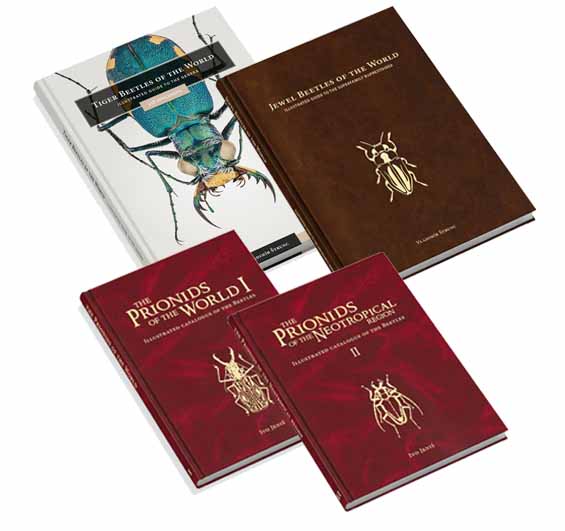
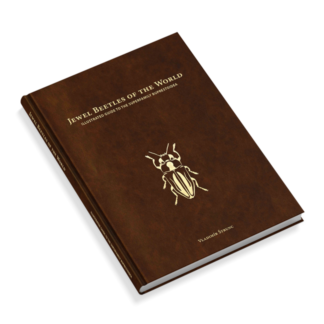
Jewel Beetles of the World
An Illustrated Guide to the Superfamily Buprestoidea
Jewel Beetles of the World, Buprestidae is a comprehensive and visually rich monograph dedicated to one of the most striking groups of Coleoptera. The family Buprestidae, commonly known as jewel beetles or metallic wood-boring beetles, is renowned for its extraordinary iridescent coloration, diverse body forms, and close ecological ties to woody plants. This volume presents a global overview of the superfamily Buprestoidea, documenting 504 species and subspecies belonging to 111 genera, thereby offering one of the most extensive pictorial treatments of this lineage currently available.
The book is conceived as a high-quality illustrated identification guide, combining scientific rigor with exceptional visual presentation. Each species is documented through carefully selected, high-resolution photographs that emphasize diagnostic morphological characters, coloration patterns, and structural details observable from dorsal and lateral perspectives. These images are specifically designed to support reliable identification based on external morphology, making the book valuable not only for professional taxonomists but also for advanced amateurs, insect photographers, and educators.
Scientific framework and taxonomic reliability
The taxonomic backbone of the publication is firmly grounded in modern buprestid systematics. Expert supervision was provided by Václav Kubáň (Šlapanice u Brna, Czech Republic), a leading authority on Buprestidae. The nomenclature, authorship, spelling, and year of publication of all included taxa follow the most up-to-date and authoritative sources, primarily the World Catalogue of the Superfamily Buprestoidea (Bellamy, 2008–2009) and the second supplemented edition of the Catalogue of Palaearctic Coleoptera (Kubáň, 2016). Where more recent taxonomic revisions were available, data were updated accordingly, incorporating works by Hołyński, Moore & Vidal, Frank & Sekerka, and others.
Species identifications were verified entirely on the basis of photographic material, cross-referenced with extensive comparative resources. Taxa from the Palaearctic and Oriental regions were confirmed directly by V. Kubáň using his private collection and specialist library, while specimens from other zoogeographical regions were verified through a combination of private material, the collections of the Entomological Department of the National Museum in Prague, and relevant literature. Selected genera—such as Belionota, Chrysodema, Cyphogastra, Paracupta, and Iridotaenia—were further refined following detailed expert commentary by Daniel Frank (Prague, Czech Republic), ensuring a high degree of taxonomic accuracy.
Structure and content
The book is divided into several clearly structured sections. The main photographic catalogue forms the core of the volume and is complemented by a section illustrating specimens alongside geographical distribution maps, enabling readers to place individual species within a global biogeographical context. The final part consists of tabulated species lists, presenting concise collection data such as country, locality, and date of capture for selected taxa. This combination of imagery, distributional data, and structured lists makes the book equally suitable for identification, comparative study, and reference.
In addition to taxonomy and morphology, the book provides contextual insights into the biology and ecology of jewel beetles, including host-plant associations and feeding strategies. Larvae of most Buprestidae are xylophagous, developing within wood or beneath bark, while adults often feed on foliage, flowers, or plant exudates. These ecological notes help readers understand not only what jewel beetles look like, but also how they interact with their environments.
Audience and educational value
As the inaugural title in the FAMILIES SERIES, this publication is intentionally designed to bridge the gap between scientific literature and visually oriented nature books. While maintaining a solid scientific foundation, it is accessible to a broad audience, including nature enthusiasts, amateur collectors, educators, and conservation-minded readers. A particular emphasis is placed on inspiring younger generations to appreciate insect diversity and to recognize the importance of conserving the natural habitats upon which these highly specialized beetles depend.
In summary, Jewel Beetles of the World, Buprestidae stands as a definitive illustrated reference on the global diversity of jewel beetles. By combining authoritative taxonomy, meticulous verification, and outstanding photographic documentation, it represents both a valuable scientific resource and a celebration of one of the most visually captivating families of beetles.