Genus Apterodela Rivalier, 1950
Remarkable Flightless Tiger Beetles of East Asia
The Ultimate Visual Guide to Tiger Beetles
Abstract: The genus Apterodela represents a distinctive group of flightless tiger beetles (Cicindelidae) characterized by large body size, reduced wings, and remarkable adaptations to terrestrial life. Recent taxonomic revisions have elevated Apterodela to full generic status and recognized two subgenera containing eight species distributed across East Asia and eastern North America. This article reviews the systematics, biology, distribution, and ecology of these fascinating beetles, highlighting their evolutionary significance and conservation importance.




Systematics
Taxonomic History and Classification
The genus Apterodela was originally established by Rivalier in 1950 as a subgenus of Cylindera, with Cicindela ovipennis Bates, 1883 designated as the type species. The name Apterodela derives from Greek roots meaning “wingless,” reflecting the most conspicuous characteristic of these beetles. For decades, Apterodela was treated as a subgenus within the large and taxonomically complex genus Cylindera. However, molecular phylogenetic studies conducted by Sota and colleagues in 2011, combined with morphological evidence, demonstrated that Apterodela forms a monophyletic clade distinct from other Cylindera lineages. This finding, coupled with the documented polyphyly of Cylindera, led to the elevation of Apterodela to full generic status in recent systematic treatments.
Current Taxonomy
A comprehensive revision published by Matalin, Wiesner, Xiong, and Araki in 2024 recognized two subgenera within Apterodela. The nominate subgenus Apterodela sensu stricto currently includes seven species: A. ovipennis from Japan, A. bivirgulata with two subspecies from eastern and central China, A. lobipennis from central China, A. kazantsevi from southeastern China, A. latissima from Yunnan Province, and A. alopecomma from Sichuan Province. The newly established subgenus Protoapterodela contains two species: A. shirakii from Taiwan and A. unipunctata from the eastern United States, representing a remarkable biogeographic disjunction between East Asia and North America.
Diagnostic Features
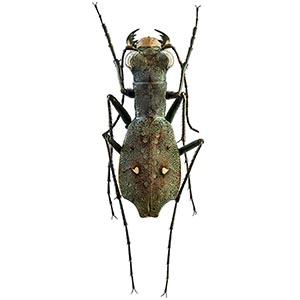
Members of the genus Apterodela are distinguished from other tiger beetles by several key morphological characters. They are relatively large beetles, typically ranging from 14 to 18 millimeters in body length, making them among the larger representatives of the Cicindelidae. The most distinctive feature is their vestigial or greatly reduced wings, rendering all species flightless. The elytra exhibit characteristic structural modifications, including poorly concave or nearly flat elytral discs, sloping shoulders, and a distinct subapical sinuation. The pronotum is characteristically longitudinal with straight sides that converge toward the base. The labrum is transverse and typically four-setose. Coloration varies among species but generally includes metallic bronze, coppery, or greenish hues on the dorsal surface, with variable pale maculation patterns on the elytra.
Bionomics and Mode of Life
Morphological Adaptations to Flightlessness
The evolution of flightlessness in Apterodela represents a significant life history adaptation associated with habitat specialization. Phylogenetic evidence suggests that flightlessness evolved independently in tiger beetles multiple times, often in association with stable and isolated habitats. In Apterodela, the loss of flight capability is accompanied by several compensatory adaptations. The beetles possess robust, well-developed legs adapted for rapid terrestrial locomotion. The body structure has become more heavily sclerotized, possibly providing enhanced protection in the absence of escape-by-flight behaviors. These morphological modifications reflect a fundamental shift in predator avoidance strategies and foraging ecology.
Life Cycle and Development
Ecological studies of Apterodela ovipennis in Japan have provided insights into the life history of these beetles. Research by Matsumoto published in 2021 documented aspects of the ecology and life cycle of this species over multiple seasonal periods. Like other tiger beetles, Apterodela species are predaceous throughout their life cycle. Adults are active hunters that pursue prey on the ground surface, while larvae construct vertical burrows in suitable substrate and ambush passing arthropods. The larval development period appears to be extended, possibly spanning multiple years, though detailed life cycle data remain limited for most species. Adult beetles are primarily diurnal hunters, though some flightless tiger beetle genera show crepuscular or nocturnal activity patterns.
Biogeographic Implications
Molecular phylogenetic analyses using mitochondrial and nuclear DNA sequences have revealed important insights into the evolutionary history and biogeography of Apterodela. The divergence among endemic species in Taiwan, Japan, and mainland Asia occurred during the Pliocene epoch, approximately 2.1 to 4.7 million years ago. This ancient divergence is consistent with the flightlessness of these beetles, as limited dispersal capability would promote geographic isolation and speciation. The phylogenetic evidence suggests that dispersal of Apterodela ancestors occurred across extended landmasses in East Asia during periods of lower sea levels in the Pliocene, when land bridges connected what are now isolated islands. The presence of Apterodela unipunctata in eastern North America represents an intriguing biogeographic puzzle, possibly reflecting ancient Laurasian connections or long-distance dispersal events in the evolutionary past of the lineage.
Distribution
Geographic Range
The genus Apterodela exhibits a distinctive disjunct distribution pattern spanning East Asia and eastern North America. In Asia, the genus reaches its greatest diversity in China, with species distributed across multiple provinces including Yunnan, Sichuan, Hubei, Jiangxi, Jiangsu, Zhejiang, Shaanxi, Henan, Shanxi, Gansu, Qinghai, and Inner Mongolia. Apterodela ovipennis is endemic to Japan, where it occurs across Honshu and other main islands, with historical records extending to Hokkaido. Apterodela shirakii is restricted to the mountainous regions of Taiwan. The single North American representative, Apterodela unipunctata, occurs in forested regions of the eastern United States, with documented records from Tennessee, Virginia, West Virginia, and surrounding states in the Appalachian region.
Altitudinal Distribution
Many Apterodela species occupy montane or submontane habitats, with some species recorded at elevations ranging from 700 to 1000 meters above sea level. This altitudinal preference may reflect both climatic requirements and the availability of suitable stable forest habitats at mid-elevations. The restriction of several species to mountain systems underscores their limited dispersal capability and vulnerability to habitat fragmentation.
Preferred Habitats
Forest Floor Environments
Apterodela species are characteristically associated with stable forest floor habitats in temperate and subtropical regions. Unlike many tiger beetles that inhabit open, sunny habitats such as sandy shores, salt flats, or grasslands, Apterodela species have adapted to the shaded conditions of forest understories. This habitat preference is consistent with hypotheses linking flightlessness in tiger beetles to habitat stability and permanence. Forest floor environments provide relatively constant microclimatic conditions, reduced temperature extremes, and stable substrate characteristics that favor sedentary predators with limited dispersal capability.
Substrate Requirements
The specific substrate requirements of Apterodela species appear to vary among taxa, but generally involve relatively firm, well-drained soils with adequate organic matter content. These substrate conditions are necessary both for adult foraging activities and for larval burrow construction. The larvae require soil that maintains burrow integrity while allowing excavation, typically a balance between cohesiveness and workability. Some species may show preferences for specific soil types or forest floor characteristics, though detailed ecological studies are lacking for most taxa.
Conservation Implications
The specialized habitat requirements and limited dispersal capability of Apterodela species render them potentially vulnerable to habitat loss and fragmentation. Forest clearing, alteration of forest floor conditions through intensive forestry practices, and climate change all pose potential threats to these species. The endemic nature of several species, particularly those restricted to isolated mountain systems or islands, heightens conservation concerns. However, the conservation status of most Apterodela species has not been formally assessed, and population data are generally lacking. The documentation of new species and subspecies in the recent revision underscores both the incompleteness of our knowledge and the importance of continued survey efforts in potential habitat areas.
Scientific Literature Citing the Genus
Primary Taxonomic Works
Molecular Phylogenetics and Biogeography
Natural History and Ecology
Regional Faunal Works
Morphological and Systematic Studies
Conclusion
The genus Apterodela represents a fascinating example of evolutionary adaptation within the Cicindelidae, demonstrating how the loss of flight capability can accompany specialization to stable forest floor habitats. The recent taxonomic revision has clarified the systematic position of these beetles and described new taxa, but many aspects of their biology, ecology, and conservation status remain poorly understood. Future research should focus on detailed life history studies, population genetics, and habitat requirements to inform conservation strategies for these distinctive and potentially vulnerable beetles. The biogeographic disjunction between Asian and North American species invites further phylogenetic investigation to resolve the evolutionary history and dispersal patterns of this remarkable lineage.